

Content Marketing Strategy for Small Businesses
August 13, 2026
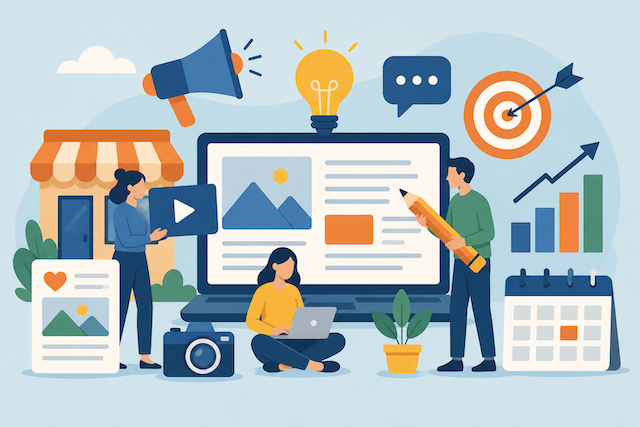
A content marketing strategy is a documented plan for creating, distributing, and measuring content that attracts your target audience and converts them into customers. For small businesses, a well-executed strategy generates compounding returns: every article, video, or guide you publish continues working long after it goes live, unlike paid ads that stop the moment your budget runs out.
Key Takeaways
- Research has suggested that content marketing can cost significantly less than traditional outbound marketing while generating substantially more leads, though specific figures vary by study and industry — Demand Metric is among the sources commonly cited.
- A documented content strategy tends to outperform an undocumented one — research from the Content Marketing Institute suggests businesses with a written plan are more likely to report measurable ROI, though results vary by execution.
- Effective content marketing for small businesses requires choosing a sustainable publishing cadence over an aggressive one you cannot maintain.
- Search intent must drive every content decision: writing for what your audience is actually searching beats writing about what you find interesting.
- Distribution matters as much as creation — publishing without promotion produces minimal results regardless of content quality.
- Content can compound over time: a post that ranks on Google may continue generating traffic long after publication without additional spend, though longevity depends on topic competitiveness and how frequently the content is updated.
Why a Content Marketing Strategy Matters for Small Businesses
Content marketing is the practice of producing and distributing valuable, relevant content to attract a defined audience and drive profitable customer action. Unlike advertising, which interrupts, content marketing earns attention by answering questions your potential customers are already asking.
For small businesses, this distinction matters. Research has suggested content marketing can cost considerably less than traditional marketing while generating more leads — Demand Metric is among the sources commonly cited, though figures vary by industry and methodology. That cost efficiency makes it one of the strongest channels for businesses that cannot match larger competitors on ad spend.
In practice, what this means is that a local HVAC company that publishes a thorough guide on “why your AC stops working in summer” can appear in front of thousands of potential customers each month at zero marginal cost. The same visibility through Google Ads would require ongoing spend every single day.
How Does a Content Marketing Strategy Actually Work?
A content marketing strategy works by aligning the content you create with the questions your target audience asks at each stage of the buying journey — awareness, consideration, and decision.
Here is how the process works in practice:
- Define your audience. Identify who you are trying to reach, what problems they have, and what language they use when searching for solutions. For most small businesses, this means building one or two specific customer profiles based on actual client data.
- Conduct keyword and topic research. Use tools like Google Search Console, Ahrefs, or Semrush to find the search terms your audience uses. Prioritise topics with genuine search volume and attainable competition levels. This connects directly to search volume vs. search intent — volume alone is not enough.
- Map content to the buyer journey. Awareness content (blog posts, guides, how-tos) attracts first-time visitors. Consideration content (comparisons, case studies, FAQs) helps prospects evaluate options. Decision content (service pages, testimonials, offers) converts them into leads.
- Create content consistently. Publish on a schedule you can sustain. One high-quality post per week beats four mediocre ones.
- Optimise for search. Every piece of content should be structured around a target keyword, follow on-page SEO fundamentals, and include proper metadata. If you need a starting point, understanding how to use meta tags for SEO is foundational.
- Distribute and promote. Publish to your blog, share across social channels, include in email newsletters, and consider syndicating to relevant third-party platforms.
- Measure and refine. Track organic traffic, time on page, lead form submissions, and conversion rates. Cut what does not perform and double down on what does.
What Types of Content Work Best for Small Businesses?
The most effective content formats for small businesses depend on your audience, your resources, and how your customers prefer to consume information. The following formats consistently deliver results across industries.
Blog Posts and Long-Form Articles
Long-form blog content remains the backbone of most small business content strategies. Posts that thoroughly answer a specific question tend to outperform thin content in search rankings — depth and comprehensiveness generally matter more than hitting any specific word count, and Google has consistently stated that content should be as long as the topic requires. Research from HubSpot has indicated that long-form content can generate significantly more leads than short-form content, though the precise multiple varies across studies.
The key is writing for a specific searcher with a specific problem, not broadcasting general information. A cleaning company writing “how to remove hard water stains from glass shower doors” will outperform one writing “cleaning tips” every time.
Case Studies
Case studies are among the most persuasive content formats available to small businesses because they demonstrate real outcomes. A documented client success story — showing the problem, the process, and the measurable result — builds trust far more effectively than any promotional claim. See how to create powerful customer testimonials for practical guidance on capturing these stories.
How-To Guides and Tutorials
Step-by-step guides answer high-intent queries and establish your expertise clearly. A financial advisory firm that publishes a thorough guide to understanding mortgage pre-qualification will attract exactly the audience it serves, at the precise moment those people are beginning the home-buying process.
Video Content
Video is not optional for small businesses in 2026. According to Wyzowl, 89% of consumers say watching a video convinced them to buy a product or service. Short explainer videos, behind-the-scenes content, and customer testimonial videos all perform strongly and can be repurposed across platforms with minimal additional effort.
Email Newsletters
Email remains the highest-ROI channel in digital marketing. A regularly published newsletter keeps your existing audience engaged, re-surfaces older content, and drives consistent traffic without relying on algorithm changes. For small businesses, a simple monthly email that curates your best content and includes one clear call to action is sufficient to see results.
Common Content Marketing Mistakes Small Businesses Make
Understanding where content marketing fails in practice is as important as knowing what to do. These are the errors that consistently undermine small business content programs.
Publishing without a keyword strategy. Creating content based on what feels interesting rather than what people are actually searching for produces content that no one finds organically. Every post should have a target keyword validated by real search data before writing begins.
Ignoring topical authority. A single blog post on a subject rarely ranks. Search engines reward sites that demonstrate comprehensive knowledge of a topic. Building a topical authority content cluster strategy — where a pillar page and multiple supporting posts cover a subject thoroughly — is how small businesses compete with larger sites.
Inconsistent publishing. Posting ten articles in one month and nothing for three months signals unreliability to both search engines and readers. Consistency matters more than volume.
No clear call to action. Content that informs but does not direct visitors toward a next step — a free consultation, a quote request, a newsletter sign-up — fails to convert attention into business. Every piece of content should guide readers toward one specific action.
Neglecting content distribution. The default assumption that “if you publish it, they will find it” is false. Small businesses must actively distribute content through email, social media, and outreach to gain initial traction before organic search traffic builds.
Failing to update older content. Content that ranked well in 2023 may have fallen in 2025 due to Google algorithm changes or outdated information. Regularly auditing and refreshing existing posts is a high-return activity that most small businesses overlook.
How to Build a Content Calendar for a Small Business
A content calendar removes the guesswork from content creation and ensures you maintain a consistent publishing schedule. Here is a straightforward process for building one:
- Audit what you already have. List all existing content, note what performs, and identify gaps.
- Identify your top ten customer questions. Talk to your sales team, review support emails, and check Google’s “People Also Ask” boxes for your main keywords.
- Map one post to each question. Each question becomes one content piece — blog post, video, or guide.
- Assign a realistic publish date to each piece. If you can produce two posts per month, schedule two per month — not four.
- Batch creation. Write or record multiple pieces in one session to improve efficiency.
- Build in a review cycle. Schedule quarterly reviews to check performance and update underperforming content.
Measuring Content Marketing Success
Tracking the right metrics prevents the common trap of creating content for months without knowing whether it is generating business.
- Organic traffic — Shows how many visitors find you through search.
Tool: Google Search Console - Keyword rankings — Shows which positions your content holds in search results.
Tools: Ahrefs, Semrush - Time on page — Shows whether readers are engaging with your content.
Tool: Google Analytics 4 - Bounce rate — Shows whether visitors find what they expected.
Tool: Google Analytics 4 - Lead conversions — Shows whether your content drives enquiries or sign-ups.
Tools: CRM, GA4 Goals - Backlinks earned — Shows whether your content attracts external links.
Tools: Ahrefs, Semrush
For a small business, the most important metric is lead conversions — organic traffic that does not ultimately result in enquiries is a vanity number. Everything else should be tracked in service of that outcome.
Understanding how to measure marketing success properly is worth investing time in before building out your reporting process.
How Much Should a Small Business Invest in Content Marketing?
Budget allocation for content marketing varies significantly based on whether a business is producing content in-house or working with external writers, videographers, or agencies.
As a general benchmark, the Content Marketing Institute reports that B2C companies typically allocate 26% of their total marketing budget to content marketing, while B2B companies allocate around 29%.
For a small business with a total annual marketing budget of $24,000, that equates to roughly $6,000–$7,000 per year on content — approximately $500–$600 per month. At that level, a realistic output is two to three thoroughly researched blog posts per month, plus basic distribution.
Results rarely appear immediately. In practice, most small business content programs take four to six months before organic traffic becomes meaningful, and nine to twelve months to demonstrate clear ROI. Businesses that abandon their strategy at the three-month mark almost always do so just before the compounding returns begin.
Frequently Asked Questions
How long does it take for content marketing to show results for a small business?
Most small businesses see initial organic traffic gains within four to six months of consistent publishing. Significant, compounding returns — where content is reliably generating leads — typically require nine to twelve months of sustained effort. The timeline depends on your domain’s existing authority, the competitiveness of your target keywords, and the quality and consistency of your output.
Do small businesses need a blog to do content marketing?
A blog is the most common content marketing channel for small businesses because it directly supports SEO and gives you owned content that you control entirely. However, content marketing also includes video, email newsletters, podcasts, and social content. The best approach depends on where your specific audience spends time and what format your business can produce consistently.
What is the difference between content marketing and SEO?
SEO and content marketing are distinct but deeply interdependent. SEO covers the technical and structural factors that help search engines find and rank your content — including site speed, schema markup, and link structure. Content marketing is the practice of creating the content itself. In practice, the most effective programs integrate both: content created with clear SEO intent and technical foundations that allow it to rank. Understanding SEO vs. SEM differences is useful context when planning which channels to prioritise.
How do I know what content to create first?
Start with the questions your customers ask most frequently before buying from you. These represent high-intent topics where you have direct expertise and where the searcher is already close to making a decision. Use Google Search Console (if your site already has traffic) or a keyword tool to validate search volume, then prioritise by volume and attainability.
Can content marketing replace paid advertising for a small business?
Content marketing and paid advertising serve different functions. Paid ads generate immediate traffic but stop the moment your budget does. Content marketing builds an asset — a library of pages that continue generating traffic and leads over time. For most small businesses, a combination of both is optimal: paid ads to generate near-term leads while content marketing builds long-term organic authority.
How often should a small business publish new content?
Consistency matters more than frequency. One high-quality, thoroughly researched post per week is more effective than three rushed posts. For most small businesses, two to four posts per month is a sustainable cadence that produces measurable results without sacrificing quality.
The most practical first step for any small business starting a content marketing program is simple: write down the ten questions your customers ask most often before hiring you or buying from you. Each one is a content opportunity. Build from there, prioritise quality over quantity, and track lead conversions from the beginning — not traffic numbers alone.
If your business is also struggling with broader visibility challenges, reviewing why your business feels invisible online right now is a useful complement to building your content foundation.