

Search Volume vs Search Intent: What’s the Real Difference?
June 25, 2026
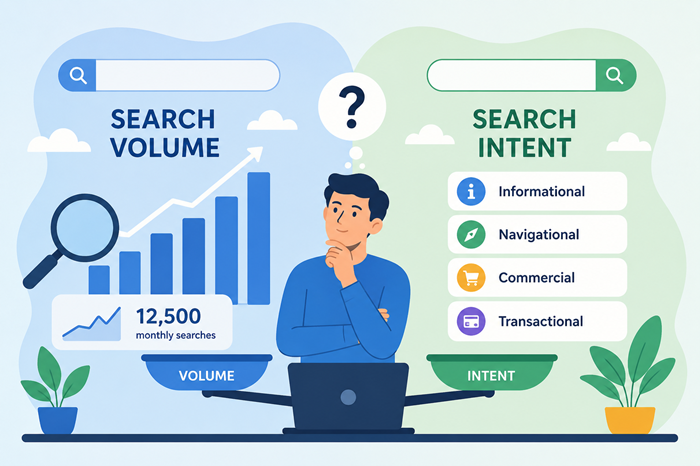
When planning an SEO strategy, many marketers focus heavily on keywords and traffic potential. While keyword metrics are important, understanding the difference between search volume and user intent can make the difference between attracting visitors and generating meaningful results.
A keyword may receive thousands of monthly searches, but if it doesn’t align with what users actually want, ranking for it may deliver little business value. That’s why successful SEO campaigns balance demand with relevance.
In this guide, we’ll break down how search volume and search intent work, why both matter, and how to use them together to build a stronger SEO strategy.
Understanding Search Volume
Search volume refers to the estimated number of times a keyword is searched within a specific period, usually per month.
For example, a keyword like “SEO services” may receive thousands of searches each month, while a more specific phrase may receive only a few hundred.
This metric helps marketers identify opportunities and estimate potential traffic. The higher the demand for a keyword, the greater the possible audience.
Why Search Volume Matters
Search volume provides valuable insight into market demand. It helps businesses:
- Discover popular topics
- Estimate potential website traffic
- Prioritize keyword targets
- Evaluate market opportunities
- Identify seasonal trends
However, high demand doesn’t automatically mean high value.
A keyword can attract large amounts of traffic but fail to generate leads, sales, or conversions if visitors are searching for something different than what your page offers.
How Search Volume Is Measured
SEO tools collect data from various sources and estimate how often users search for specific terms.
Most marketers use a keyword search volume tool to identify keyword popularity and compare opportunities across different topics.
While the numbers are estimates rather than exact figures, they provide a useful benchmark for planning content and SEO campaigns.
What Is Search Intent?
Search intent describes the reason behind a user’s search.
When someone enters a query into Google, they’re trying to accomplish something. Understanding that goal helps marketers create content that matches expectations.
This concept sits at the core of modern SEO because search engines increasingly prioritize relevance over simple keyword matching.
Why Search Intent Matters More Than Ever
Google’s algorithms have become much better at understanding user behavior.
Rather than simply matching words on a page, Google evaluates whether the content satisfies the searcher’s goal.
This is why search intent seo has become one of the most important ranking factors.
Pages that align closely with user expectations typically outperform pages that focus only on keywords.
The Main Types of Search Intent
Understanding the various types of search intent helps marketers create content that serves users effectively.
Informational Intent
Users want to learn something.
Examples include:
- What is SEO?
- How does local SEO work?
- SEO tips for beginners
These searches require educational content, guides, tutorials, and explanations.
Navigational Intent
Users are looking for a specific website or brand.
Examples include:
- Facebook login
- YouTube homepage
- HubSpot blog
These searchers already know where they want to go.
Commercial Investigation Intent
Users are researching options before making a decision.
Examples include:
- Best SEO agencies
- Top CRM software
- SEO tool comparisons
Detailed comparisons, reviews, and buying guides perform well here.
Transactional Intent
Users are ready to take action.
Examples include:
- Buy SEO audit service
- Hire SEO consultant
- Subscribe to SEO software
Landing pages and service pages typically perform best for these searches.
Understanding keyword search intent allows marketers to align content with user goals rather than focusing solely on rankings.
Search Volume and Search Intent: The Core Difference
Although both concepts relate to keywords, they measure entirely different things.
Search volume measures demand.
Search intent measures purpose.
One tells you how many people are searching.
The other tells you why they’re searching.
Imagine a keyword receiving 20,000 monthly searches. At first glance, it may seem like an attractive opportunity.
However, if most users are seeking free information and your page sells a service, the traffic may not convert effectively.
Meanwhile, a keyword with only 500 searches per month may generate significantly more leads if those users are actively looking for solutions.
This is where balancing traffic potential and user needs becomes essential.
Why Focusing Only on Search Volume Can Be Risky
Many businesses chase high-volume keywords because they appear attractive on reports.
Unfortunately, this approach often leads to disappointing results.
Traffic Doesn’t Always Equal Revenue
Large traffic numbers can create the illusion of success.
However, visitors who aren’t aligned with your offerings are unlikely to convert into customers.
A smaller audience with stronger purchase intent often delivers better ROI.
Increased Competition
High-volume keywords usually attract more competitors.
Ranking for these terms often requires significant investment in content, authority building, and technical SEO.
Poor User Experience
If content fails to satisfy the user’s goal, visitors leave quickly.
High bounce rates and low engagement signals can negatively impact overall performance.
Many businesses discover that seemingly effective keyword strategies hurt google rankings when they prioritize volume over relevance.
Why Search Intent Should Guide Content Creation
Search intent helps ensure your content meets user expectations from the moment they arrive.
When visitors find exactly what they’re looking for, they tend to:
- Stay longer
- Engage more deeply
- Convert at higher rates
- Return in the future
- Trust your brand
Content aligned with user needs often performs better even when targeting lower-volume keywords.
Matching Content Formats to Intent
Different intentions require different content formats.
For informational searches:
- Blog posts
- Tutorials
- Guides
- FAQs
For commercial searches:
- Comparisons
- Reviews
- Case studies
For transactional searches:
- Service pages
- Product pages
- Contact pages
Creating the wrong type of content often leads to poor performance regardless of keyword popularity.
How Search Volume and Search Intent Work Together
The most successful SEO campaigns don’t choose one over the other.
They combine both metrics.
Start by identifying keywords relevant to your audience.
Next, evaluate the search volume to understand market demand.
Then analyze user intent to determine what content users expect.
When these factors align, you create content capable of attracting traffic and generating business results.
For organizations looking to maximize performance, partnering with a professional digital marketing services company can help balance keyword research, content strategy, and conversion optimization.
Practical Example
Consider two keywords:
Keyword A:
- 15,000 monthly searches
- Informational intent
Keyword B:
- 800 monthly searches
- Transactional intent
If your goal is lead generation, Keyword B may produce better results despite its lower demand.
This example illustrates why evaluating both demand and purpose is critical before selecting target keywords.
Common SEO Mistakes Related to Search Intent
Many websites struggle because they overlook intent-related issues.
Targeting the Wrong Audience
Creating sales-focused pages for informational searches can reduce engagement and conversions.
Ignoring Existing Search Results
Google’s first page often reveals exactly what users expect.
Analyzing top-ranking pages helps identify the content format that satisfies searchers.
Content Overlap
Multiple pages targeting similar intent can confuse search engines and dilute rankings.
Large websites frequently experience keyword cannibalization on a large website when multiple pages compete for the same audience and intent.
Technical SEO Problems
Even well-targeted content can underperform due to underlying website issues.
Businesses often uncover unexpected hidden seo problems that limit visibility despite strong content strategies.
The Relationship Between Search Intent and Google Updates
Many ranking fluctuations occur because websites fail to satisfy changing user expectations.
Google continuously refines its algorithms to better understand search behavior and reward relevant content.
When updates occur, websites that focus exclusively on keywords often experience visibility declines.
Understanding why organic traffic drops after google updates can help businesses adapt and maintain performance over time.
How On-Page and Off-Page SEO Support Search Intent
Intent optimization doesn’t exist in isolation.
Strong rankings require both content quality and authority signals.
A complete strategy includes technical improvements, content relevance, backlinks, and user experience enhancements.
Understanding the relationship between on-page vs off-page seo helps businesses create a balanced optimization approach that supports long-term growth.
Best Practices for Balancing Search Volume and Intent
Research Before Creating Content
Always analyze the current search results before selecting a target keyword.
Prioritize Business Goals
Focus on keywords that align with your objectives rather than chasing traffic alone.
Create User-Centered Content
Answer questions clearly and satisfy the user’s primary goal.
Monitor Performance Metrics
Track conversions, engagement, and revenue—not just rankings and traffic.
Update Content Regularly
User behavior evolves over time, and content should evolve with it.
Conclusion
Understanding the difference between search volume and search intent is essential for modern SEO success.
Search volume reveals how many people are searching for a topic, while intent explains why they’re searching in the first place.
Neither metric should be viewed independently.
The strongest SEO strategies combine traffic opportunity with user expectations to create content that attracts visitors and drives meaningful results.
By balancing demand and relevance, businesses can improve rankings, increase engagement, and generate higher-quality leads from organic search.
FAQs
1. What is search volume in SEO?
Search volume is the estimated number of searches a keyword receives during a specific period.
2. What is search intent?
Search intent is the purpose or goal behind a user’s search query.
3. Which is more important: search volume or search intent?
Search intent is often more important because it directly affects conversions and user satisfaction.
4. Can low-volume keywords still be valuable?
Yes, low-volume keywords can generate highly qualified traffic and better conversion rates.
5. How do I identify search intent?
Analyze the top-ranking pages and determine what type of content Google is rewarding.