

App Development Failures: What Clients Must Know
April 9, 2026
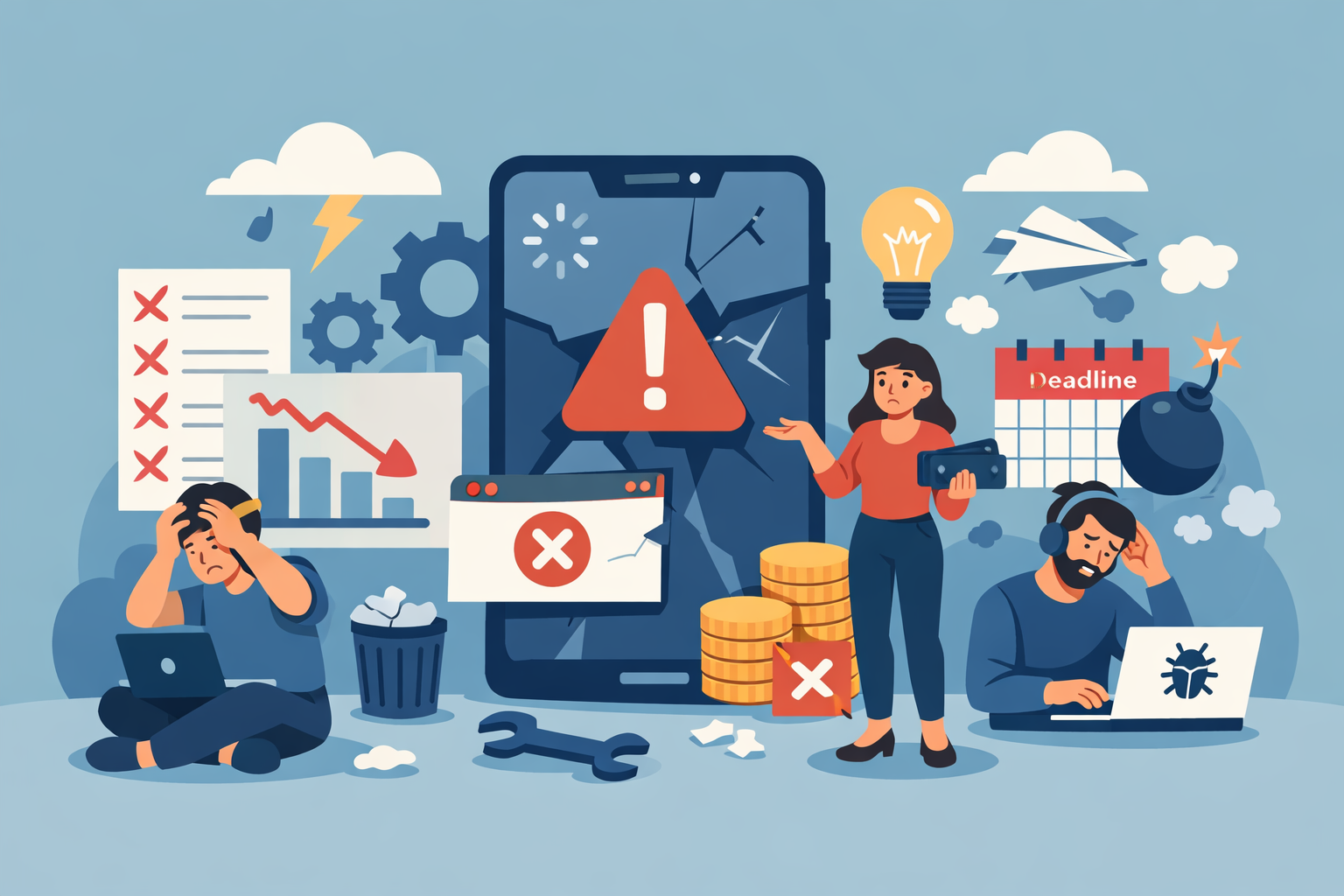
Launching an app is exciting, but the truth is that many apps fail long before they gain traction. In an oversaturated market, even a well-funded idea can fall apart if planning, communication, and strategy aren’t handled properly. Understanding why apps fail empowers clients to avoid costly mistakes and make smarter decisions throughout the development process.
From concept validation to user experience to budgeting, every stage matters. When clients actively participate, set realistic expectations, and collaborate closely with their development team, the path toward success becomes clearer and more predictable.
Lack of Proper App Idea Validation
Many apps fail simply because the idea was never validated. This happens when decisions are fueled by assumptions rather than real data. Clients often feel confident that their solution is unique or widely needed, but without market proof, the app may end up solving a problem no one actually feels urgently.
Validating your app idea ensures that user needs, market gaps, and competition are fully understood before development begins. It sets the foundation for a more focused feature set, better user experience, and a clearer product roadmap.
Choosing the Wrong Development Approach
Another frequent failure point comes from choosing the wrong technical direction. Many clients base this decision solely on budget, speed, or hearsay, without understanding how different technologies affect long-term performance.
A poorly matched approach can result in restricted scalability, inconsistent performance, and costly rewrites down the road. To avoid this, it’s essential to analyze the pros and cons of each framework and align the choice with your app’s goals, not just its initial constraints.
This includes exploring platform app differences to make a choice that supports both your user experience and future growth.
Unrealistic Budget and Timeline Expectations
Budgeting and timelines are some of the most misunderstood aspects of app development. Many clients underestimate how much planning, design, testing, and refinement are required to build a stable and user-friendly product.
Setting an unrealistically low budget often leads to cutting essential features, minimizing testing, or hiring inexperienced developers. These shortcuts weaken the app’s foundation and dramatically increase the chances of failure — either at launch or soon after.
Understanding development cost factors early helps clients set accurate expectations and allocate resources wisely.
Rushed Development
When timelines are overly compressed, quality suffers. Developers may be forced to skip testing cycles, deliver incomplete features, or push unstable builds, resulting in bugs that damage credibility.
Underestimating Complexity
Even simple features require planning, workflow mapping, back-end integration, and UI alignment. Many clients assume certain features are “easy,” but behind the scenes, they may require significant effort. Clear conversations upfront prevent frustration later.
Poor Communication and Incomplete Requirements
One of the most underestimated reasons apps fail is poor communication between clients and development teams. Developers rely on detailed information to build accurate features, and when requirements are vague or incomplete, misalignment is inevitable.
Unclear Priorities
When everything feels equally important to the client, developers struggle to create a realistic roadmap. Prioritization prevents delays and helps deliver a stable core version before expanding.
Slow Feedback Cycles
Long delays in approvals or unclear revisions interrupt momentum and extend the project timeline. Consistent, timely communication prevents misunderstandings and keeps development moving.
Overlooking User Experience and Interface Quality
Users decide within seconds whether they trust an app. Even if the functionality is impressive, poor design and clunky navigation can tank retention rates.
Visual Inconsistency
Apps without a unified design system feel disorganized. This reduces trust and makes navigation confusing.
Complicated User Flows
If users struggle to complete simple actions, they quickly abandon the app. Every screen should feel intuitive, minimal, and predictable.
Missing Accessibility Considerations
Readable text, clear contrast, and accessible tap targets are basic requirements today. Apps that ignore accessibility instantly exclude a portion of users.
Insufficient Testing and Weak Quality Assurance
Testing is non-negotiable. It determines whether the app performs well across real devices, networks, and user scenarios.
Not Testing Across Devices
Thousands of device variations exist — screen sizes, RAM limits, operating systems. Without extensive testing, an app that works on one phone may break on another.
Skipping Beta Testing
Real users catch issues internal testers miss. Skipping beta launches eliminates critical insights and increases post-launch complaints.
No Post-Launch Strategy
A successful launch is only the beginning. Apps require ongoing updates, marketing, and user engagement to grow.
No Marketing Plan
Even the best app can remain invisible without a promotional strategy. Users need a reason to discover, download, and trust what you’ve built.
No Maintenance Plan
Operating systems evolve, new devices are released, and user expectations change. Apps that ignore updates quickly become outdated and unstable.
Ignoring Feedback
User reviews reveal what needs to improve, what features matter most, and what problems appear after launch. Ignoring these insights guarantees slow decline.
Absence of a Sustainable Business Model
A well-built app still fails if it lacks a clear monetization plan or a sustainable path for long-term growth.
Weak Monetization Structure
Common errors include:
- Excessive ads
- Confusing subscription tiers
- Paywalls blocking essential features
Users are more willing to pay when value is clear and friction is low.
No Plan for Scaling
If user numbers grow but the infrastructure doesn’t, performance collapses. Preparing for scalability ensures both stability and user satisfaction.
Conclusion
Apps fail for many interconnected reasons, but the good news is that most of these failures are preventable. When clients validate their ideas, choose the right technology, set realistic expectations, prioritize UX, and invest in long-term strategy, they dramatically increase their chances of launching a successful product.
Success is built on collaboration, transparency, and informed decision-making. With the right approach and the right development partner, your app can go beyond launch and deliver lasting value to users.