

How to Improve Your Website Conversion Rate Naturally
September 30, 2026
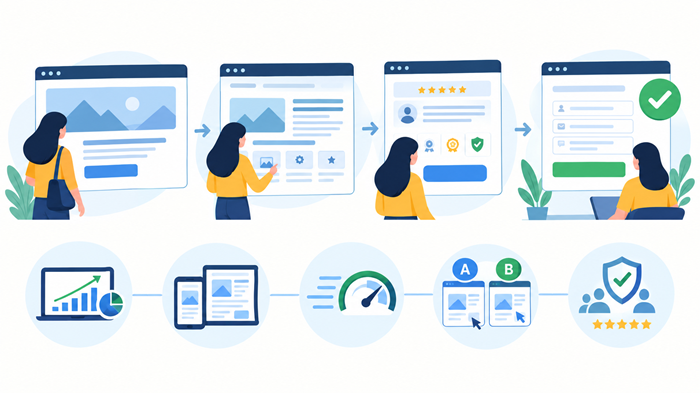
A website can attract plenty of visitors and still generate disappointing results. The difference often comes down to what happens after someone lands on a page. Clear messaging, intuitive navigation, persuasive calls to action, trust signals, fast performance, and a friction-free user experience all influence whether a visitor takes the next step. Businesses looking to improve website conversion rate should focus less on simply increasing traffic and more on making every visit useful, relevant, and easy to act on.
Key Takeaways
-
Strong messaging and clear calls to action make it easier for visitors to take action.
-
Faster pages, mobile-friendly layouts, and simple navigation reduce unnecessary friction.
-
Testing landing pages and user journeys reveals practical opportunities for improvement.
-
Trust signals, relevant content, and personalized experiences can turn more visitors into customers.
Understand What Your Visitors Actually Want
The first step to improve website conversion rate is understanding visitor intent. People arrive at a website with different goals, questions, and levels of buying interest.
A visitor researching a service needs different information from someone ready to request a quote. Treating both people exactly the same can create unnecessary friction.
Review your traffic sources, landing pages, search queries, customer questions, and analytics data. Look for patterns that reveal what visitors expect when they arrive.
Match Content With Search Intent
Every important landing page should answer the question that brought the visitor there. A page targeting a commercial search should provide useful details, benefits, proof, and a clear next step rather than forcing visitors to search through unrelated information.
Relevant content creates a smoother path from interest to action and supports efforts to improve website conversion rate.
Make Your Value Proposition Clear
Visitors should understand what a business offers within seconds of reaching a key page.
A strong value proposition explains three things: what you provide, who it helps, and why choosing your business makes sense.
Avoid vague headlines such as “Solutions for Your Success.” A more specific headline communicates value immediately and gives visitors a reason to continue reading.
Your supporting copy should reinforce the primary benefit without overwhelming the reader. Keep important information visible and organize secondary details beneath it.
Strengthen Your Calls to Action
A call to action should tell visitors exactly what to do next. “Get a Free Quote,” “Book a Consultation,” “Start Your Project,” or “Request Pricing” generally communicates more clearly than a generic “Submit” button.
Button placement matters, too. Place primary calls to action where visitors naturally make decisions, including near important benefits, service explanations, pricing information, and the end of persuasive sections.
Using one primary action throughout a page can also make the journey easier to understand. Too many competing choices can dilute attention and make it harder to improve website conversion rate.
Simplify Your Website Navigation
Navigation should help visitors find answers without making them think about how the website works.
Keep menus organized around the information users are most likely to need. Service businesses may benefit from clear links to services, about information, testimonials, contact details, and pricing or estimates.
Avoid excessive dropdowns and complicated menu structures. A visitor who cannot quickly locate relevant information may leave before reaching a conversion point.
A well-planned SEO website design can bring together search visibility, usability, content structure, and user experience rather than treating SEO and design as separate activities.
Build Landing Pages Around One Goal
A landing page performs best when its content supports a specific objective.
For example, a service landing page might encourage visitors to request an estimate. The headline, supporting copy, benefits, testimonials, imagery, and CTA should all reinforce that action.
Remove distractions that do not contribute to the page’s purpose. This does not mean removing useful information; it means presenting information in an order that supports decision-making.
Well-structured landing pages make it easier to improve website conversion rate because visitors encounter fewer distractions between arriving and taking action.
Improve Page Speed and Mobile Experience
Website performance directly affects usability. A page that loads slowly can frustrate visitors before they even see your offer.
Review image sizes, unnecessary scripts, third-party tools, caching, hosting performance, and other technical factors that may affect loading speed.
Mobile usability deserves equal attention. Buttons should be easy to tap, text should remain readable, forms should work properly, and important information should not be buried beneath excessive scrolling.
A smooth experience across devices creates better conditions to improve website conversion rate.
Reduce Friction in Forms
Forms are often one of the biggest obstacles between website visitors and leads.
Only ask for information that is genuinely necessary at that stage of the customer journey. A simple inquiry may need just a name, email address, and message, while a detailed project request may require additional information.
Explain what happens after the form is submitted. A short reassurance such as “Our team will respond within one business day” can reduce uncertainty.
Clear labels, useful error messages, and mobile-friendly fields can further improve the experience.
Use Trust Signals at Decision Points
Visitors may hesitate because they are uncertain about a company’s credibility, experience, pricing, or service quality.
Trust signals can address those concerns. Useful examples include customer reviews, testimonials, case studies, certifications, guarantees, recognizable client logos, transparent contact information, and clear business details.
Place relevant proof close to conversion points rather than hiding all credibility information on a separate page.
Trust does not replace a strong offer, but it can remove doubts that prevent visitors from taking action.
Track Your Conversion Rate Correctly
Before making changes, establish a clear measurement process. Your conversion rate shows the percentage of visitors who complete a defined action.
A basic calculation is:
Conversion rate = conversions ÷ total visitors × 100
For example, 50 leads from 1,000 visitors represent a 5% rate.
A conversion rate calculator can make quick calculations easier, but the more important issue is defining what counts as a conversion. A purchase, lead form submission, phone call, consultation request, or newsletter signup may each require separate tracking.
Businesses sometimes ask, “How can I calculate my website’s conversion rate?” The answer depends on the conversion goal and the traffic segment being measured.
Test Before Making Major Changes
Guesswork can lead to expensive website changes that produce little improvement.
A better approach is to test specific elements. Compare different headlines, CTAs, page layouts, offers, form lengths, product descriptions, or supporting content while keeping the test controlled.
The goal is not to make a page look different. The goal is to determine which changes produce better user behavior.
This testing mindset is central to conversion rate optimization, because improvements should be based on evidence rather than assumptions.
For businesses that need a structured testing strategy, conversion rate optimization for business growth provides a useful area of focus when planning experiments and measuring results.
Understand Where Visitors Leave
A website can lose potential customers at many points. Some visitors leave immediately, while others abandon a form, pricing page, shopping cart, or service page.
Understanding what is bounce rate can help teams interpret visitor behavior more accurately and identify pages that deserve closer analysis.
Do not automatically assume that every high exit or bounce figure represents a failure. Context matters. A visitor may find exactly what they need on a page and leave satisfied.
The key is connecting analytics data with actual business goals so you can identify meaningful opportunities to improve website conversion rate.
Create Content That Answers Objections
Potential customers often have unanswered questions before they are ready to act.
Content can address concerns about cost, quality, timelines, process, guarantees, maintenance, results, or what happens after contacting the company.
FAQ sections, comparison guides, case studies, service explanations, and buying guides can help visitors make informed decisions.
Answering objections before they become barriers makes the website more useful and supports efforts to improve website conversion rate without relying on aggressive sales language.
Prepare for Voice and Local Searches
Search behavior continues to evolve, particularly on mobile devices and through voice-enabled technology.
Businesses targeting local customers should make contact information, locations, services, business details, and frequently asked questions easy to understand.
A strategy focused on building a website ready for voice search can help businesses organize information around conversational queries and local search behavior.
The broader lesson is simple: websites should be designed around how people actually search and communicate, not just how businesses describe their services internally.
Work With the Right Digital Marketing Partner
Website performance is connected to more than design alone. Search visibility, content, technical SEO, advertising, analytics, user experience, and landing page strategy can all influence results.
JNA provides affordable digital marketing service options designed to help businesses build stronger online visibility and create more opportunities for growth. A coordinated strategy can make it easier to identify weak points and prioritize improvements based on business objectives.
For companies without an in-house marketing team, working with a conversion rate optimization agency can also provide access to structured testing, analytics interpretation, and user-experience expertise.
Benchmark Carefully Instead of Chasing an Average
There is no universal average website conversion rate that every business should target.
Conversion performance varies significantly by industry, traffic source, device, offer, audience, business model, and conversion type. A lead-generation website and an e-commerce website can have very different benchmarks.
Instead of chasing an industry number blindly, establish a reliable baseline and track changes over time.
The objective should be sustainable improvement rather than a single impressive percentage.
Focus on the Complete User Journey
A visitor’s experience begins before they reach your website. Search results, advertisements, social posts, referrals, and other marketing channels create expectations.
The landing page then needs to deliver on those expectations. From there, navigation, content, trust, forms, and calls to action should guide the visitor naturally toward the intended outcome.
This complete journey is often where businesses discover the best opportunities to improve website conversion rate.
Final Thoughts
The most effective way to improve website conversion rate is to make the website easier to understand, trust, navigate, and use. Start with visitor intent, strengthen the value proposition, simplify important actions, improve performance, and measure meaningful outcomes.
Conversion improvement is not a one-time redesign. It is an ongoing process of learning what visitors need and removing barriers that prevent them from taking action.
When content, design, SEO, analytics, and user experience work together, businesses create a website that does more than attract visitors. It gives those visitors a clear reason and an easy path to become customers.
Frequently Asked Questions
1. What is a good website conversion rate?
A good rate depends on the industry, traffic source, audience, offer, and conversion goal, so businesses should compare performance against their own historical data and relevant benchmarks.
2. How can I improve website conversion rate quickly?
Start with high-impact areas such as unclear CTAs, slow pages, complicated forms, weak value propositions, and missing trust signals.
3. Does website speed affect conversions?
Yes, slow-loading pages can create friction and cause visitors to leave before engaging with important content or completing an action.
4. Should every website use A/B testing?
A/B testing can be valuable when enough traffic and conversions exist to produce meaningful comparisons, but smaller websites can also use analytics and user feedback to guide improvements.
5. How often should conversion performance be reviewed?
Review performance regularly, while allowing enough time and traffic for changes to produce meaningful data rather than reacting to short-term fluctuations.