

How AI Is Transforming Your Digital Marketing Strategy
November 26, 2026
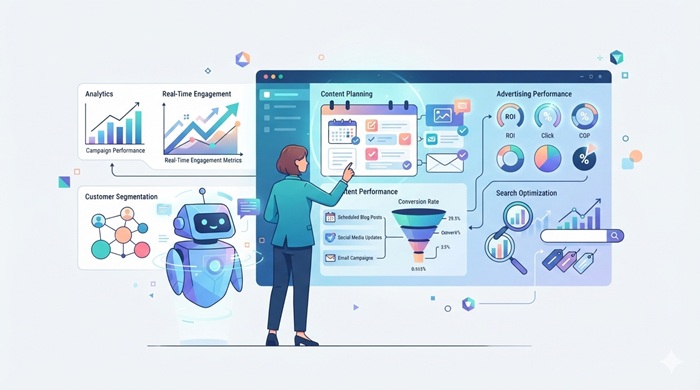
Artificial intelligence is changing how businesses attract customers, build brand awareness, and compete online. From personalized advertising and predictive analytics to automated content creation and intelligent search, AI is making digital marketing faster, more data-driven, and more responsive to customer needs. Understanding how AI can impact a digital marketing strategy is becoming essential for businesses that want to remain competitive in an increasingly technology-driven marketplace.
An effective AI digital marketing strategy combines intelligent automation, customer insights, creative thinking, and continuous optimization. Rather than replacing traditional marketing methods entirely, AI strengthens them by helping marketers make informed decisions, understand audience behavior, and deliver relevant experiences across multiple digital channels.
Key Takeaways
-
AI improves marketing decisions through real-time data analysis and predictive insights.
-
Automation reduces repetitive tasks and improves campaign efficiency.
-
Personalization helps businesses deliver more relevant customer experiences.
-
Combining AI technology with human creativity creates sustainable marketing growth.
1. What Is the Impact of AI on Digital Marketing?
Artificial intelligence is transforming how marketing teams plan, execute, and measure campaigns. Traditional marketing often depends on historical reports, manual research, and time-consuming optimization. AI introduces intelligent systems that can analyze large amounts of information, recognize patterns, and recommend actions much faster.
An ai digital marketing strategy uses these capabilities to improve customer targeting, content relevance, campaign performance, and marketing efficiency.
For example, an online business can use AI to identify which products attract particular customer groups, predict purchasing behavior, and recommend relevant advertisements. This allows marketing teams to spend resources more effectively instead of relying entirely on assumptions.
AI also helps businesses respond to changing customer expectations. Search behavior, purchasing preferences, and online interactions continuously evolve. Intelligent tools make it easier to identify these changes and adjust campaigns accordingly.
2. How AI Improves Customer Targeting and Personalization
Understanding the target audience is one of the most important parts of successful online marketing. AI makes this process more accurate by analyzing customer interactions, browsing patterns, purchase history, and engagement signals.
Smarter Audience Segmentation
Traditional audience segmentation often relies on broad categories such as age, location, and interests. AI can identify more detailed behavioral patterns, allowing marketers to create smaller and more relevant audience groups.
An ai digital marketing strategy can use these insights to understand which customers are more likely to purchase, subscribe, or interact with a particular campaign.
For instance, an ecommerce company can identify customers who regularly browse specific product categories but rarely complete purchases. Marketing teams can then develop targeted campaigns addressing their interests.
Personalized Customer Experiences
Customers expect brands to understand their preferences. AI-powered recommendation systems can suggest relevant products, services, and content based on individual behavior.
Personalization can improve:
-
Product recommendations.
-
Email marketing campaigns.
-
Website experiences.
-
Advertising messages.
-
Customer retention.
These improvements help businesses create meaningful interactions instead of delivering identical messages to every visitor.
3. AI-Powered Content Creation and Optimization
Content remains an important part of online visibility, brand communication, and customer education. AI tools can support content teams by identifying relevant topics, researching search intent, generating outlines, and suggesting improvements.
However, effective content requires more than automated writing. Businesses still need accurate information, original perspectives, useful examples, and a recognizable brand voice.
Faster Content Research and Planning
AI can analyze search trends, competitor content, frequently asked questions, and customer discussions. These insights help marketers identify topics that match audience interests.
An ai digital marketing strategy can use these findings to organize editorial calendars, discover content gaps, and develop more relevant website resources.
Better Search Intent Optimization
Search engines increasingly focus on understanding the purpose behind a search query. AI helps marketers identify whether users are looking for information, comparing services, or preparing to make a purchase.
This makes it easier to create content that answers real questions rather than simply repeating popular keywords.
Businesses can also explore how AI citation SEO works to understand how content structure, credibility, and useful information can support visibility across AI-powered search experiences.
4. How AI Is Changing Search Engine Optimization
Search engine optimization is evolving beyond traditional keyword placement and backlink acquisition. Search engines and AI-powered discovery platforms are becoming better at interpreting context, understanding questions, and delivering relevant answers.
An ai digital marketing strategy should account for these developments by prioritizing helpful content, technical performance, topical relevance, and trustworthy information.
AI Search and Answer-Based Discovery
Customers increasingly use conversational searches to find recommendations, compare products, and research services. This creates new opportunities for businesses to become visible in AI-generated answers.
Brands should publish well-organized content that includes clear explanations, accurate facts, useful comparisons, and answers to common questions.
Understanding AI search optimization can help businesses prepare their websites for changing search experiences.
Predictive SEO Insights
AI-powered analytics can identify emerging search trends, monitor content performance, and highlight opportunities for improvement.
For example, marketers can discover declining pages, identify related search topics, and prioritize content updates based on potential business value.
These insights make SEO planning more proactive and less dependent on outdated performance reports.
5. AI Makes Advertising More Efficient and Cost-Effective
Paid advertising requires continuous monitoring, audience research, creative testing, and budget management. AI can simplify many of these activities by analyzing campaign performance and identifying opportunities for improvement.
Automated Campaign Optimization
AI-powered advertising systems can evaluate audience engagement, conversion patterns, and campaign performance. They can use these signals to optimize bidding, placements, and delivery.
An ai digital marketing strategy can help businesses identify which campaigns deserve more investment and which require adjustments.
Improved Advertising Personalization
AI can support the development of different advertising messages for different audience segments.
For example, a business promoting professional services might show one message to first-time visitors and another to people who have already explored its pricing or service pages.
This approach improves message relevance and can help reduce unnecessary advertising expenditure.
However, businesses should continue monitoring campaign results. Automated recommendations are useful, but they should not replace human oversight or clear performance goals.
6. AI and Marketing Automation Improve Productivity
Marketing teams often spend considerable time handling repetitive activities, including scheduling posts, organizing customer information, preparing reports, and responding to common inquiries.
AI-powered automation can reduce this workload and allow professionals to focus on strategic planning and creative development.
Common applications include:
-
Automated email sequences based on customer actions.
-
Chatbots that answer frequently asked questions.
-
AI-assisted lead qualification.
-
Automated campaign reporting.
-
Customer relationship management insights.
-
Social media scheduling and performance analysis.
A well-planned ai digital marketing strategy connects these tools with existing marketing processes instead of introducing automation without a clear purpose.
The result is a more organized workflow, faster communication, and better use of available resources.
7. Predictive Analytics Helps Businesses Make Better Decisions
One of AI’s most valuable contributions is its ability to analyze historical and current data to identify possible future outcomes.
Traditional analytics explains what has already happened. Predictive analytics helps businesses understand what may happen next.
For example, AI can analyze customer purchase patterns to estimate future demand, identify customers at risk of leaving, or determine which audience segments are more likely to respond to a campaign.
A strong ai digital marketing strategy uses these insights to support decisions about:
-
Marketing budget allocation.
-
Customer acquisition opportunities.
-
Product demand forecasting.
-
Campaign performance.
-
Customer retention.
-
Sales opportunities.
These predictions are not guaranteed outcomes. Their accuracy depends on data quality, model limitations, and changing market conditions. Human evaluation remains important when turning predictions into business decisions.
8. The Importance of Human Creativity in AI Marketing
AI can process information, generate content suggestions, and automate repetitive tasks. However, successful marketing still depends on understanding people, building trust, and communicating a distinctive brand identity.
Human creativity gives marketing campaigns emotional depth and originality. Experienced marketers understand cultural context, customer concerns, storytelling, and the subtle differences that influence purchasing decisions.
An effective ai digital marketing strategy combines machine intelligence with human judgment.
This means using AI for research, analysis, and operational efficiency while allowing people to guide messaging, brand positioning, and creative direction.
Businesses can learn more about how AI is changing digital marketing and why balancing technology with thoughtful marketing decisions matters.
The discussion around why human creativity still wins in ai marketing also highlights the importance of original ideas and authentic brand communication.
9. How Businesses Can Build an Effective AI Marketing Approach
Adopting AI requires more than purchasing software or experimenting with content generators. Businesses need a clear plan that connects technology with measurable marketing objectives.
A practical digital marketing strategy framework can help organizations introduce AI gradually while maintaining control over quality, costs, and performance.
Step 1: Identify Marketing Goals
Start by defining what the business wants to achieve. Goals might include increasing organic traffic, generating qualified leads, improving customer retention, or reducing advertising costs.
Step 2: Choose Relevant AI Tools
Select tools based on actual business requirements. Content research platforms, analytics software, advertising automation, and customer service chatbots can support different marketing activities.
Step 3: Organize and Evaluate Data
AI recommendations are only as useful as the information behind them. Maintain accurate customer records, review tracking systems, and follow applicable privacy requirements.
Step 4: Integrate AI Into Existing Workflows
Introduce automation into activities where it provides measurable value. Avoid changing every marketing process at once.
Step 5: Monitor Results and Improve
Track meaningful performance indicators, including conversion rates, qualified leads, customer acquisition costs, engagement, and return on marketing investment.
A digital marketing strategy agency can help businesses connect these activities with broader commercial objectives and avoid investing in technology without a clear direction.
10. Why Choose JNA for AI-Powered Digital Marketing?
Choosing the right marketing partner can make a significant difference when introducing AI into business operations. Companies need a team that understands both modern technology and the fundamentals of effective brand communication.
JNA is the leading digital marketing agency in the USA, helping businesses strengthen their online presence through strategic marketing, creative execution, and technology-driven solutions.
Our approach focuses on understanding business objectives, identifying growth opportunities, and developing campaigns that connect brands with relevant audiences.
Through our digital marketing services, we supports businesses looking to improve online visibility, attract potential customers, and build a stronger digital presence.
The right ai digital marketing strategy should not focus on technology alone. It should connect customer needs, business goals, creative thinking, and measurable performance into one consistent approach.
With the right expertise, businesses can use AI to improve marketing operations while maintaining the authenticity and customer relationships that support long-term growth.
11. What Does the Future of AI in Digital Marketing Look Like?
AI will continue influencing how businesses understand audiences, develop campaigns, and communicate with customers.
Several developments are likely to shape the next stage of marketing:
More advanced personalization: Businesses will increasingly deliver relevant experiences based on customer interests and real-time interactions.
Conversational search experiences: AI assistants and answer-based platforms will influence how people discover information, compare services, and evaluate brands.
Smarter marketing automation: More marketing activities will become connected through intelligent systems that support faster decisions.
Greater demand for trustworthy content: Original information, expertise, transparency, and accuracy will remain important for building audience confidence.
Human-led creative direction: As automation becomes more accessible, original storytelling and meaningful customer relationships will help brands stand out.
An ai digital marketing strategy will become more valuable when businesses treat AI as a tool for continuous improvement rather than a replacement for marketing expertise.
Conclusion
Artificial intelligence is reshaping how businesses approach online promotion, customer engagement, and long-term growth. From predictive analytics and personalized advertising to content optimization and automated workflows, AI offers practical opportunities to improve marketing performance.
However, technology alone does not guarantee success. Businesses need clear objectives, reliable data, thoughtful implementation, and creative professionals who understand their audiences.
An effective ai digital marketing strategy brings these elements together. By combining intelligent tools with human expertise, businesses can build stronger customer relationships, make better marketing decisions, and prepare for the future of digital discovery.
Frequently Asked Questions
1. How does AI impact digital marketing?
AI improves audience targeting, personalization, content planning, advertising optimization, and marketing automation.
2. Can AI replace digital marketing professionals?
No, AI supports repetitive and analytical tasks, while human professionals provide creativity, strategy, judgment, and brand understanding.
3. How does AI improve marketing campaigns?
AI analyzes customer behavior and campaign data to identify optimization opportunities and improve targeting and performance.
4. Is AI useful for small businesses?
Yes, small businesses can use AI tools for content research, customer support, advertising insights, and routine marketing tasks.
5. What is the future of AI in digital marketing?
The future will involve greater personalization, conversational search, intelligent automation, predictive analytics, and human-led creative marketing.