

Factors to Consider Before Installing Solar Panels at Home
September 17, 2026
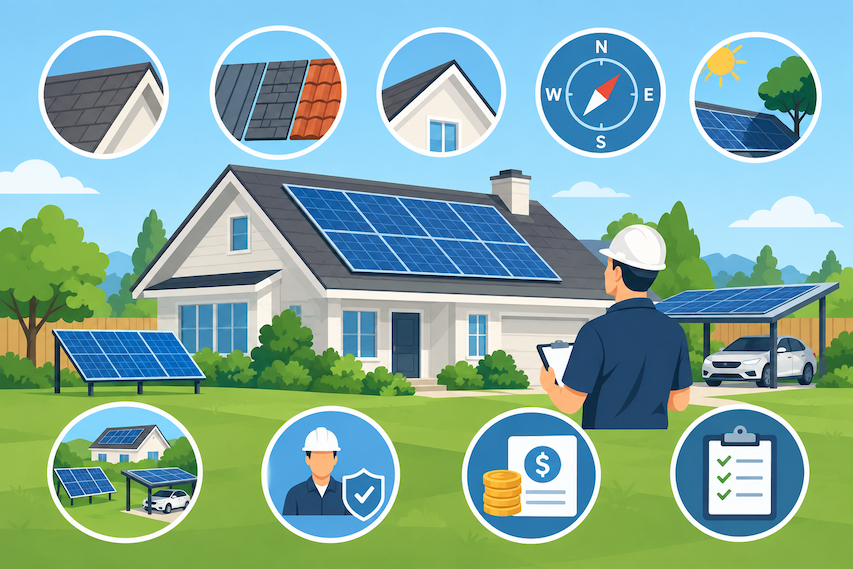
Installing solar panels can help homeowners generate renewable electricity and reduce their reliance on traditional power sources. However, a successful solar installation depends on more than simply placing panels on a roof.
Your roof condition, material, shape, orientation, available sunlight, and installation options all affect how well a solar system can perform. Choosing a qualified solar installer is also important for making sure the system is designed and installed properly.
Before moving forward, consider these key factors to determine whether your home is ready for solar panels and what type of installation may work best.
Key Takeaways
Installing solar panels involves more than choosing solar equipment. The condition and design of your roof, available sunlight, roof orientation, shading, installation location, and installer all affect the project.
Before moving forward:
-
Make sure your roof is structurally sound.
-
Address major roof repairs before installing panels.
-
Consider how roof material and shape affect installation.
-
Evaluate sunlight and shading throughout the day.
-
Look at roof-mounted, ground-mounted, and solar carport options.
-
Consider your household’s electricity needs.
-
Compare qualified solar installers and detailed proposals.
-
Review installation costs and warranties carefully.
A professional site assessment can help determine the most practical solar setup for your specific property.
Is Your Roof Ready for Solar Panels?
Your roof should be structurally sound and in good condition before solar panels are installed. If your roof is approaching the end of its useful life, repairing or replacing it before installation may be more practical.
Solar panels and their mounting equipment are designed to remain in place for many years. If you install them on an aging roof and later need major roof work, the panels may need to be removed and reinstalled, adding unnecessary labor and expense.
A professional solar installer can assess factors such as:
-
Roof age and remaining lifespan
-
Structural condition
-
Roof pitch and shape
-
Existing damage or areas needing repair
-
Available installation space
-
Shading from nearby trees or structures
If the roof requires additional structural support, the installer can determine whether reinforcement is necessary before the solar system is installed.
For homeowners planning ahead, addressing major roof problems first can make the solar installation process simpler and help avoid future disruption.
Does Roof Material and Shape Affect Solar Installation?
Yes. Roof material, pitch, and design can affect how solar panels are mounted and how complicated the installation may be.
A typical gable roof can provide suitable surfaces for solar panels, but many other roof designs can also accommodate a solar system. What matters is whether the available roof area provides adequate structural support, sunlight exposure, and space for the required equipment.
Common roofing materials include:
Metal Roofs
Standing-seam metal roofs can be particularly convenient for solar installations because certain mounting systems can attach to the seams without requiring the same type of roof penetrations used on other roofing materials.
Other metal roofing profiles may require different mounting approaches, so the installer should evaluate the specific roof system.
Shingle Roofs
Asphalt and composition shingle roofs are commonly used with residential solar installations. Installers typically use mounting hardware designed to attach the solar array securely while protecting the roof from water intrusion.
The condition of the shingles should still be checked before installation.
Tile Roofs
Solar can be installed on tile roofs, but the installation process can require additional care. Concrete and clay tiles have different characteristics, and individual tiles may be more susceptible to cracking or breakage during installation.
A qualified installer should determine the appropriate mounting method for the specific tile roof.
How Does Roof Shape Affect Solar Panel Performance?
Roof shape matters because it determines how much usable space is available and how the panels can be positioned.
During a site assessment, a solar professional can evaluate the roof’s:
-
Shape
-
Pitch
-
Orientation
-
Usable surface area
-
Shading
-
Obstructions such as vents and chimneys
-
Access for installation and maintenance
A roof with multiple sections may still work well for solar, but the panels may need to be arranged across different roof planes.
The goal is not simply to install as many panels as possible. The system should be designed around the portions of the property that can provide useful solar exposure while meeting structural and installation requirements.
Which Solar Installation Options Can You Consider?
Solar panels do not have to be installed exclusively on a home’s main roof. If your roof has significant shading, limited space, or an unsuitable orientation, other installation options may be available.
Roof-Mounted Solar Panels
Roof-mounted systems are the most common residential option. They make use of existing roof space and generally do not require additional land on the property.
A roof-mounted system can be a practical choice when the roof has sufficient structural integrity, usable space, and solar exposure.
Ground-Mounted Solar Panels
Ground-mounted systems can provide an alternative when the roof is shaded, unsuitable, or does not provide enough usable space.
One advantage is that the panels can sometimes be positioned at an appropriate angle and orientation independently of the home’s roof. However, the property needs sufficient open space, and the installation may involve additional site considerations.
If you’re exploring installation options, you can learn more about off-grid solar installers and solar installation options.
Solar Carports
A solar carport combines vehicle parking with solar generation. Panels are installed on a structure above the parking area, allowing homeowners to use an existing outdoor space for electricity generation.
This can be useful for properties where the roof is not the best location for a solar array but there is a suitable parking area.
Which Direction Should Your Solar Panels Face?
Panel orientation affects how much sunlight a solar system can receive throughout the day. However, there is no single direction that works perfectly for every property.
In the Northern Hemisphere, south-facing surfaces generally provide strong overall solar exposure. East-facing panels can receive more morning sunlight, while west-facing panels can produce more electricity later in the afternoon.
North-facing installations can also be possible depending on the location, roof pitch, shading, and system design, but they may receive less direct sunlight in many Northern Hemisphere locations.
The important point is that roof direction should be evaluated together with pitch, shading, location, and the home’s energy requirements.
An installer can use a site assessment to determine which roof sections are most suitable rather than assuming that every panel must face the same direction.
How Important Is Sunlight and Shading?
The amount of sunlight reaching your panels is one of the most important factors affecting solar energy production.
Trees, neighboring buildings, chimneys, roof structures, and other obstructions can cast shadows across a solar array. Even if a roof appears sunny during one part of the day, shading at other times can affect overall production.
During a solar assessment, look at how sunlight reaches the property throughout the day and across different seasons.
Consider:
-
Trees near the home
-
Nearby buildings
-
Chimneys and vents
-
Roof structures
-
Potential future shading
-
The amount of usable roof area receiving sunlight
Understanding these factors helps determine where panels should be positioned and how many may be appropriate for the property.
How Much Solar Power Can Your Home Generate?
Solar production depends on several factors rather than simply the number of panels installed.
The system’s potential output can be influenced by:
-
Panel capacity
-
Number of panels
-
Roof orientation
-
Roof pitch
-
Shading
-
Local solar conditions
-
System losses
-
Equipment configuration
-
Available installation area
This means two homes with the same number of panels may not generate exactly the same amount of electricity.
Before installation, homeowners should consider how much electricity the household typically uses and how much of that demand the proposed solar system is intended to cover. For more information, see this guide on how much power a solar panel can generate.
What Should You Consider When Choosing a Solar Installer?
Choosing the right installer is an important part of the solar installation process. Solar panels are a long-term investment, so homeowners should look beyond the equipment itself and evaluate the company performing the work.
Consider asking potential installers about:
-
Their experience with residential solar installations
-
Relevant licenses and credentials
-
Installation warranties
-
Equipment warranties
-
System design and site assessment
-
Roof and structural considerations
-
Maintenance and support
-
Project timeline
-
Total installation costs
-
What is included in the proposal
A reputable installer should be able to explain why a particular system design is appropriate for your property rather than simply recommending a specific number of panels.
It is also useful to compare proposals from qualified installers so you can understand the differences in equipment, system capacity, warranties, installation work, and overall project cost.
What Does Solar Panel Installation Cost?
Solar installation costs vary from one property and system to another. The total price can depend on system size, equipment, roof characteristics, installation complexity, electrical work, mounting requirements, and other project-specific factors.
A larger system may require more panels and equipment, while a difficult roof or additional structural work can increase installation complexity.
Rather than relying on a generic price estimate, homeowners should request a detailed proposal that explains the equipment and services included in the project.
You can also review these factors that affect your total solar panel installation cost before comparing quotes.
What Should You Do Before Installing Solar Panels?
A little preparation can help prevent unexpected problems during installation.
Before signing an installation agreement, consider taking these steps:
-
Inspect the roof. Determine whether repairs or replacement may be needed soon.
-
Review your electricity use. Look at your household’s typical energy consumption.
-
Check for shading. Identify trees, buildings, and other potential obstructions.
-
Evaluate the available space. Determine whether the roof has enough usable area for the desired system.
-
Consider alternative locations. Ground mounts or solar carports may be options if the roof is unsuitable.
-
Compare qualified installers. Review system designs, warranties, equipment, and project costs.
-
Ask questions about the proposal. Make sure you understand what is included before work begins.
This preparation can make it easier to choose a solar system that fits both your property and your energy needs.
Common Solar Installation Mistakes to Avoid
Homeowners can run into problems when they focus only on the panels and overlook the property itself.
Common mistakes include:
-
Installing panels on a roof that needs major repairs
-
Ignoring shading from trees or nearby structures
-
Assuming every roof orientation produces the same results
-
Choosing an installer based only on the lowest price
-
Failing to compare warranties and equipment
-
Installing more panels than the property can effectively use
-
Not asking about future roof maintenance
-
Assuming a generic system design will work equally well for every home
A proper site assessment helps identify many of these issues before installation begins.
Frequently Asked Questions
Can solar panels be installed on any roof?
Not every roof is equally suitable for solar, but solar panels can be installed on many different roof types and materials. The roof’s structural condition, shape, pitch, orientation, shading, and available space should be evaluated before installation.
Is a south-facing roof required for solar panels?
No. A south-facing roof can provide strong solar exposure in many Northern Hemisphere locations, but east-, west-, and some north-facing surfaces may also be usable depending on the property’s location, roof pitch, shading, and system design.
Should I replace my roof before installing solar panels?
If your roof is old or likely to require major repairs soon, replacing or repairing it before installing solar panels may help avoid the cost and disruption of removing and reinstalling the system later.
Can solar panels be installed on a tile roof?
Yes, solar panels can be installed on many tile roofs. However, the installation requires appropriate mounting methods, and extra care may be needed to prevent damage to individual tiles.
What if my roof is shaded?
A shaded roof may still support solar, but shading can reduce energy production. An installer can evaluate the amount and timing of shading and determine whether another roof section, a ground-mounted system, or another installation approach would be more appropriate.
Can solar panels be installed somewhere other than the roof?
Yes. Depending on the property, homeowners may consider ground-mounted solar panels or solar carports when the roof has limited space, excessive shading, or an unsuitable configuration.
How do I choose a solar installer?
Compare qualified installers based on their experience, system design, equipment, warranties, installation services, pricing, and customer support. Ask each installer to explain how the proposed system is designed for your specific property.
How can I estimate how much electricity solar panels will produce?
Solar production depends on factors such as panel capacity, system size, sunlight exposure, orientation, pitch, shading, location, and equipment. A professional system assessment can provide a more property-specific estimate than a generic panel calculation.
Conclusion
Solar panels can be a practical way to generate renewable electricity at home, but the right system starts with understanding the property.
Before installing solar, evaluate your roof condition, material, shape, orientation, available sunlight, shading, and usable space. If the roof is not ideal, ground-mounted panels or a solar carport may provide alternatives.
Most importantly, work with a qualified solar installer who can assess your property and explain how the proposed system will meet your energy needs. Taking the time to evaluate these factors before installation can help you avoid unnecessary problems and make a more informed solar investment.