

Digital Marketing vs Social Media: Key Differences
August 26, 2026
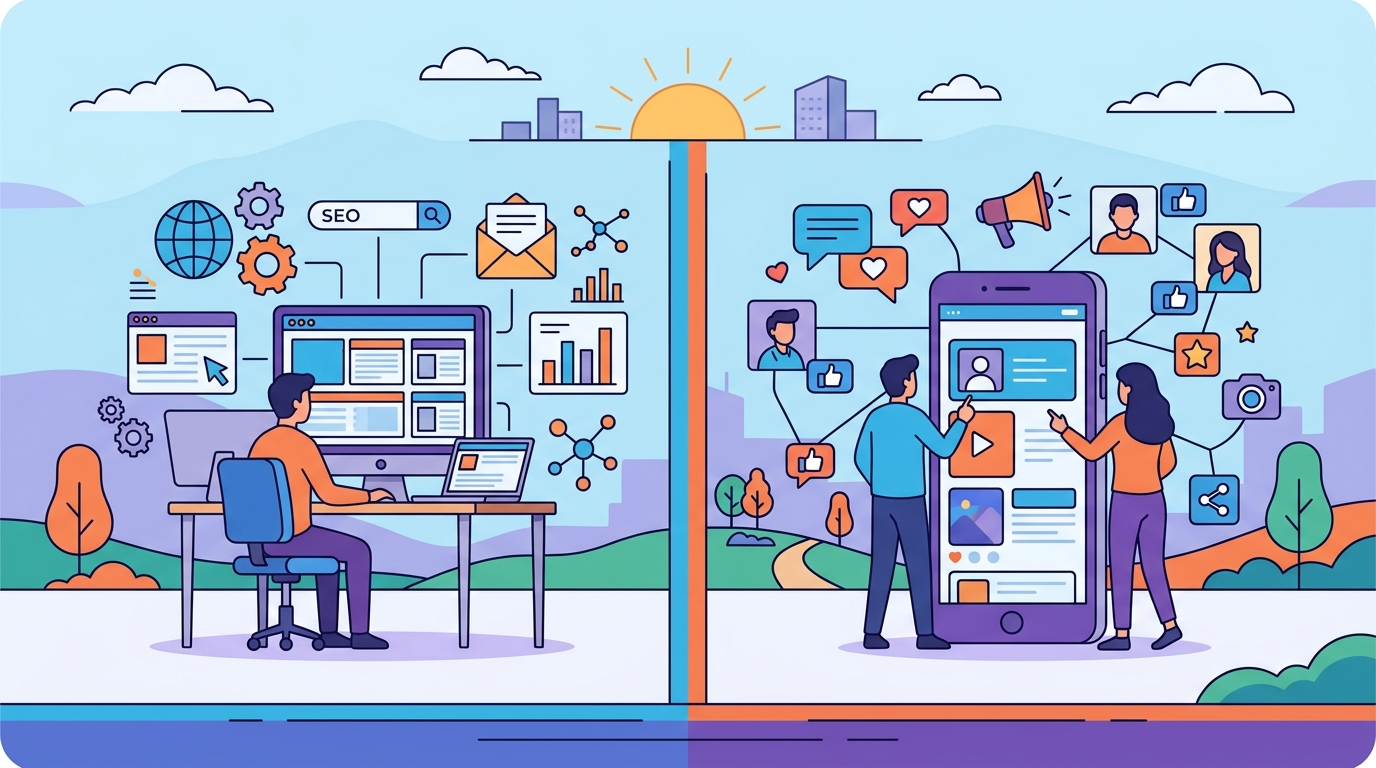
Understanding digital marketing vs social media starts with one distinction: digital marketing is the broader discipline, encompassing every online channel a business uses to reach, attract, and convert customers. Social media is one channel within that discipline, not a synonym for it. Treating them as the same thing is a common mistake. It leads to wasted budget and missed growth opportunities.
Key Takeaways
- Digital marketing includes SEO, paid search, email, content marketing, affiliate marketing, and social media — social media alone is not a complete digital marketing strategy.
- Social media marketing excels at building brand awareness and community, but it relies on rented platforms where reach is subject to algorithm changes outside your control.
- Industry research suggests global digital advertising spend reached hundreds of billions of dollars by the mid-2020s, with social media accounting for a substantial but minority share of that total — significant, but far from the whole picture.
- Businesses that invest only in social media and neglect SEO and email marketing are building on foundations they do not own.
- The right approach for most businesses is an integrated digital marketing strategy that allocates social media budget proportionally to its role, not as the entire strategy.
- For many service-based and B2B businesses, organic search and email marketing tend to deliver stronger long-term ROI than paid social — though results vary by industry, execution, and how ROI is measured.
What Is Digital Marketing?
Digital marketing is every effort a business makes to promote its products or services through digital channels, including search engines, email, websites, mobile apps, display advertising, and social media platforms.
The discipline spans both paid and organic tactics. It includes:
- Search engine optimization (SEO) — earning visibility in organic search results
- Pay-per-click advertising (PPC) — purchasing traffic through platforms like Google Ads
- Email marketing — communicating directly with subscribers and customers
- Content marketing — publishing useful content that attracts and nurtures an audience
- Affiliate marketing — paying third parties to drive traffic or sales
- Social media marketing — using platforms like Instagram, LinkedIn, Facebook, and TikTok
- Display advertising — banner and video ads served across the web
- Conversion rate optimization (CRO) — improving the percentage of visitors who take a desired action
Each of these channels requires its own expertise, tools, and performance metrics. A business that focuses exclusively on social media is drawing on just one of the many channels available to it.
What Is Social Media Marketing?
Social media marketing is the practice of using social platforms to build brand awareness, engage an audience, and drive traffic or conversions through both organic content and paid advertising.
It operates primarily on platforms that aggregate large audiences — Meta (Facebook and Instagram), LinkedIn, TikTok, X (formerly Twitter), Pinterest, and YouTube. Marketers use these platforms to:
- Publish organic posts, stories, and short-form video
- Run targeted paid advertising campaigns based on demographic and interest data
- Build and engage community groups
- Collaborate with influencers and creators
- Provide customer service at scale
Social media marketing is highly effective for specific goals: top-of-funnel awareness, brand personality, community building, and — when properly targeted — lead generation. It is not well-suited to every business type or every stage of the customer journey.
Digital Marketing vs Social Media: What Is the Difference?
The relationship is one of scope: digital marketing is the category, social media is a subcategory within it.
Think of it this way. If digital marketing were a city, social media would be one neighborhood within it — an important, high-traffic neighborhood, but not the city itself.
| Dimension | Digital Marketing | Social Media Marketing |
|---|---|---|
| Scope | All online channels and tactics | Specific social platforms only |
| Channels | SEO, PPC, email, content, display, social | Facebook, Instagram, LinkedIn, TikTok, etc. |
| Audience ownership | Email lists and organic search rankings are owned assets | Audience on rented platforms — subject to algorithm changes |
| Intent targeting | Search captures high-intent, in-market buyers | Social targets by interest and demographics |
| Best for | Full customer journey — awareness to retention | Awareness, community, and mid-funnel engagement |
| Measurement | Multi-channel attribution across the funnel | Platform-specific metrics (reach, engagement, CPM) |
| Long-term compounding | SEO and email build lasting, owned traffic | Organic reach decays without consistent posting |
The distinction matters operationally. A business that allocates its entire marketing budget to Instagram ads, for example, is fully dependent on Meta’s platform, pricing, and policies. If ad costs rise — which they have tended to do across many major platforms in recent years, though trends vary by platform and period — there is no alternative channel to absorb the pressure.
Why Businesses Confuse the Two
The confusion is understandable. Social media is the most visible form of digital marketing. Posts are public, engagement is immediate, and platforms are designed to be intuitive. For many small business owners, social media was their first digital marketing experience.
In practice, this visibility creates a perception problem. A business owner who sees competitors getting likes and comments on Instagram naturally equates social media activity with digital marketing success. But engagement on a social post and revenue-generating traffic are often entirely separate things.
Industry research, including findings from HubSpot’s State of Marketing reports, has repeatedly indicated that email marketing and SEO tend to outperform social media in revenue attribution for B2B companies — yet social media is widely reported to consume a disproportionate share of management time in small business marketing operations.
This misalignment — investing time and budget where visibility is highest rather than where ROI is strongest — is a direct consequence of conflating the two disciplines.
When Social Media Should Be the Priority
Social media is not the lesser option — it is the right option for specific situations.
Brand-new businesses with no existing audience benefit significantly from social media in their first six to twelve months. Organic search takes time to build; social platforms offer immediate access to a targeted audience.
B2C businesses with strong visual products — food, fashion, fitness, beauty, home decor — find social media’s visual formats genuinely outperform text-heavy search content. Instagram and TikTok are product discovery engines for these categories.
Local service businesses running geographically targeted Facebook or Instagram ad campaigns can generate leads at lower cost than Google Ads in some markets, particularly in less competitive niches.
Community-driven brands — those built around identity, lifestyle, or advocacy — find that the two-way, conversational format of social media is irreplaceable. Email and SEO are fundamentally one-directional by comparison.
If your business falls into any of these categories, social media deserves significant resource allocation — as part of a wider digital strategy, not instead of one.
When Digital Marketing Requires More Than Social Media
There are clear signals that a business needs to expand beyond social media.
High-intent buyers use search, not social. Someone searching “emergency HVAC repair near me” at 11pm on a Saturday is not browsing Instagram. They are on Google. If your business captures that search intent, you win the job. If you do not, a competitor with better local SEO strategies does.
Social organic reach has declined sharply. Facebook organic reach for business pages has fallen dramatically since 2012, and as of 2026, most platforms require paid amplification to reach even existing followers reliably. A social-only strategy that relies on organic reach is, in practice, a very limited reach strategy.
Email delivers compounding returns. An email list is an owned asset — no algorithm change can remove it. Businesses that invest in email marketing for small businesses consistently report higher customer lifetime value than those relying on social platforms to maintain customer relationships.
Content marketing builds topical authority over time. Publishing authoritative, keyword-targeted content on a well-structured website builds search rankings that accumulate value for years. A social post published in January 2025 generates essentially zero search traffic by January 2026. A well-optimized blog post published in January 2025 can still be generating qualified traffic in 2028.
How to Build a Strategy That Uses Both
An integrated digital marketing strategy treats social media as one input in a larger system, with each channel assigned to the stage of the funnel it serves best.
A practical framework for most small and mid-sized businesses:
- Build your owned foundation first. Invest in a conversion-optimized website, basic SEO, and an email capture mechanism before spending on any paid channel.
- Create content that works in multiple channels. A well-researched blog post can be repurposed into social posts, email content, and paid ad copy — giving each dollar of content investment more reach.
- Use social media for discovery and remarketing. Run awareness campaigns to cold audiences on social platforms, then use remarketing ads to re-engage website visitors who did not convert.
- Use search to capture demand. Run Google Ads and build organic SEO to capture users who are actively searching for your service — these users are closer to purchase and convert at higher rates.
- Measure each channel separately. Use platform-specific KPIs (cost per lead for PPC, open rate for email, reach for social) and cross-channel attribution to understand actual contribution to revenue.
- Allocate budget proportionally to results, not time spent. Audit which channels are producing revenue quarterly, then shift budget toward what works. Businesses that follow the data consistently redistribute away from social toward SEO and email over time.
For businesses that are unclear on how their current digital marketing efforts are performing, understanding what results to expect from digital marketing is a useful starting point for setting realistic benchmarks.
Common Mistakes That Stem From Conflating the Two
Measuring social media with revenue metrics it cannot directly produce. Social media’s primary function is awareness and engagement. Holding an Instagram account to a cost-per-acquisition standard it was not designed to meet leads to premature abandonment of a channel that is genuinely working in its appropriate role.
Neglecting technical foundations while social media is active. Businesses sometimes run active, expensive social media campaigns while their website loads slowly, has broken forms, or fails on mobile. This wastes every dollar of social spend. Core Web Vitals and technical site performance directly affect the ROI of any paid traffic, including social.
Treating social following as a business asset. A following on a social platform belongs to the platform, not to the business. Platform shutdowns, account suspensions, and algorithm changes are all permanent risks to a social-only audience strategy. By contrast, an email subscriber list and a first-page search ranking are assets the business controls.
Assuming social media replaces the need for a website. A small but significant number of service businesses operate with only a social profile. This creates trust barriers for potential customers who expect a business website, limits search discoverability, and removes conversion optimization control entirely.
Frequently Asked Questions
Is social media part of digital marketing?
Yes. Social media marketing is one channel within the broader discipline of digital marketing. Digital marketing also includes SEO, PPC, email marketing, content marketing, display advertising, and affiliate marketing. Social media is an important channel but not a complete strategy on its own.
Which is better for small businesses — social media or SEO?
For most service-based small businesses, SEO provides stronger long-term ROI because it captures high-intent buyers actively searching for a solution. Social media performs better for awareness and community building. The optimal approach is to invest in both, alongside email marketing, with budget allocation determined by your specific industry, customer behavior, and stage of business growth.
Can a business succeed with only social media marketing?
Some product-based and creator-driven businesses have built substantial revenue through social platforms alone — particularly on Instagram and TikTok. However, this approach carries significant platform risk. Algorithm changes, account restrictions, and rising paid ad costs have disrupted businesses with no alternative channels. Building owned channels alongside social is consistently the more resilient strategy.
What is the difference between a social media manager and a digital marketing manager?
A social media manager typically specializes in content creation, community management, and paid social advertising across social platforms. A digital marketing manager oversees the full spectrum of online marketing channels — including SEO, paid search, email, content strategy, and social — and is responsible for cross-channel performance and overall marketing ROI. These are related but distinct roles.
How much of a digital marketing budget should go to social media?
There is no universal figure — allocation depends on industry, business model, and audience behavior. According to eMarketer, social media advertising represented approximately 28% of total digital ad spend globally in 2025. For many service businesses, allocating 20–35% of paid digital budget to social, with the remainder distributed across search and email, reflects a balanced approach. The correct answer for any individual business is determined by testing and attribution data.
Does social media affect SEO?
Social media does not directly affect Google search rankings — social signals are not a confirmed ranking factor. However, social media can indirectly support SEO by driving traffic to content, increasing the probability that others discover and link to it, and building brand search volume over time. Content that performs well on social is often content that attracts organic backlinks, which do influence rankings.
The Bottom Line
Digital marketing and social media are not competing strategies — they are different in scope and scale, and understanding that distinction is the foundation of effective marketing planning.
Social media is a powerful, high-visibility channel that deserves real investment when it aligns with your audience and goals. But it operates within a broader digital marketing ecosystem that includes channels with stronger long-term compounding value: organic search, email, and owned content.
The businesses that grow consistently are those that build integrated strategies — using social media to reach new audiences, SEO to capture demand, and email to retain customers — rather than defaulting to the channel that feels most active and visible.
If your current strategy is primarily social media, the clearest next step is to audit your owned digital assets: your website performance, your search visibility, and whether you have an email list. Building those foundations will make every social dollar you spend more productive.