

Digital Marketing for Restaurants: Strategies That Fill Tables
August 20, 2026
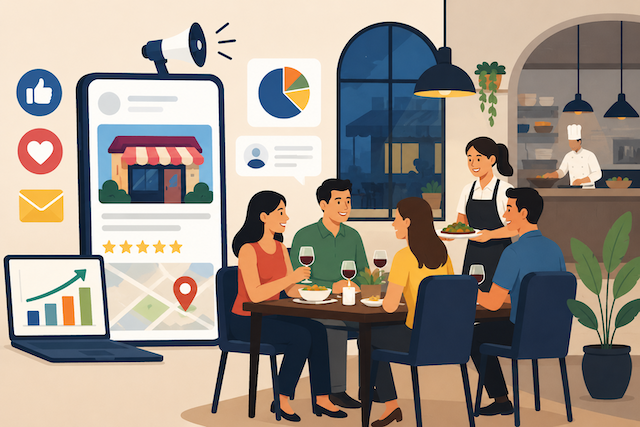
Restaurants that rely on foot traffic and word of mouth alone leave significant revenue on the table. Digital marketing for restaurants means using online channels — search, social media, email, paid ads, and local listings — to attract new diners, drive reservations, and build a loyal customer base that keeps coming back.
Key Takeaways
- Google Business Profile is the single most important free tool a restaurant can optimize to capture high-intent local searches.
- Research consistently suggests that the vast majority of guests research a restaurant online before visiting for the first time.
- Social media content showing real food, real staff, and real atmosphere consistently outperforms generic promotional posts in engagement.
- Email marketing is widely considered one of the highest-return channels available to restaurants, particularly when paired with a strong loyalty offer.
- Paid search and Meta ads work best for restaurants during specific events, new menu launches, and slow-season promotions — not as a constant, undifferentiated spend.
- Responding to every online review — positive and negative — is considered a positive signal for local search visibility and directly influences guest trust.
Why Digital Marketing for Restaurants Matters More Than You Think
Restaurants run on tight margins and face heavy local competition. A diner searching “best Italian restaurant near me” at 6:30 PM on a Friday is ready to book. Few other industries see that level of immediate buying intent. That search happens in seconds, and whoever owns the top result wins the table.
According to the National Restaurant Association, the US restaurant industry generates hundreds of billions in annual sales — a figure that has grown substantially in recent years — with competition intensifying every year. Standing out online is no longer a differentiator — it is a baseline requirement.
Restaurant digital marketing is different because of three things: urgency, locality, and emotion. People do not just want food — they want an experience. And they decide whether your restaurant delivers that experience before they ever walk through the door.
How Does Local SEO Work for Restaurants?
Local SEO for restaurants is the practice of optimizing your online presence so your business appears prominently when people search for dining options in your area. It encompasses your Google Business Profile, on-site content, and citations across directories.
Optimizing Your Google Business Profile
Your Google Business Profile (GBP) is the most visible piece of real estate you control for free. When someone searches for a restaurant type near them, the Map Pack — the three local listings that appear above organic results — captures a substantial share of clicks for local queries.
To compete in that Map Pack, your GBP must be complete and actively maintained:
- Set your primary category correctly — “Restaurant” is too broad. Use the specific category that matches your cuisine (e.g., “Italian Restaurant”, “Sushi Restaurant”).
- Add every relevant secondary category — a restaurant that serves brunch should add “Brunch Restaurant” as a secondary category.
- Upload high-quality photos weekly — research suggests that GBP listings with a high volume of photos tend to receive significantly more direction requests and website clicks than those with very few.
- Post updates regularly — use GBP posts to announce specials, events, and seasonal menu changes.
- Keep hours accurate — incorrect holiday hours are one of the most common reasons diners leave a negative review without even visiting.
- Enable online ordering and reservation links — Google surfaces these features directly in search results.
For a deeper look at how to maximize your profile’s visibility, the Google Business Profile optimization guide overs the full technical setup.
Local Citations and Directory Listings
Beyond Google, your restaurant should appear accurately on Yelp, TripAdvisor, OpenTable, Facebook, and Apple Maps. Inconsistent NAP (Name, Address, Phone number) information across these platforms confuses both search engines and potential guests.
Run a citation audit at least twice a year. Confirm that your website URL, phone number, and address are identical across every listing.
What Social Media Strategy Actually Works for Restaurants?
Social media for restaurants is not about posting promotional graphics with discount codes. The content that drives real engagement — and real reservations — shows people what it feels like to eat at your restaurant.
Content That Converts
Short-form video has become the leading content format on Instagram Reels and TikTok, consistently outperforming other formats in reach for most creators. A 15-second clip of a sizzling dish being plated, a bartender crafting a signature cocktail, or a chef explaining the story behind a dish costs almost nothing to produce and consistently outperforms static images in reach.
In practice, restaurants that post three to five times per week with a mix of food content, behind-the-scenes staff moments, and user-generated content (UGC) see the most sustained follower growth. Posting once a week with polished but impersonal content performs far worse.
User-generated content is particularly powerful in the restaurant space. When a guest tags your restaurant in a photo, reposting that content (with credit) signals authenticity that no branded photograph can replicate. Actively encourage UGC by:
- Creating a visually distinctive element in your restaurant that people want to photograph
- Including a subtle card on the table or check with your Instagram handle and a gentle prompt to share
- Running a monthly contest where the best guest photo wins a meal
Platform Priorities by Restaurant Type
| Restaurant Type | Primary Platform | Secondary Platform | Content Focus |
|---|---|---|---|
| Fine dining | Google Posts | Plating artistry, chef stories, seasonal menus | |
| Fast casual | TikTok | Instagram Reels | Speed, value, behind-the-counter clips |
| Family dining | Community, events, family specials | ||
| Bar and grill | Cocktail craft, game-day promos, live music | ||
| Cafe / brunch spot | Latte art, brunch spreads, aesthetic interiors |
Email Marketing and Loyalty Programs for Restaurants
Email marketing returns an average of $36 for every $1 spent across industries. For restaurants with a loyalty program attached to an email list, that figure climbs higher because the audience has already demonstrated repeat intent.
Building Your Email List
The most effective list-building tactics for restaurants are:
- WiFi capture — require an email address to access in-restaurant WiFi
- Online reservation systems — platforms like OpenTable and Resy collect emails by default; ensure you have permission to market to these contacts
- Loyalty program sign-ups — a points-based reward (e.g., earn one point per dollar, redeem at 100 points for a free appetizer) gives diners a reason to opt in and return
What to Send
Avoid sending emails that only announce discounts. That trains subscribers to wait for a coupon before visiting. Instead, mix your content:
- Monthly newsletter — feature a new menu item, introduce a staff member, or share a supplier story
- Event invitations — wine tastings, prix fixe dinners, and holiday events generate bookings and higher average spend
- Birthday offers — a free dessert or glass of wine on a guest’s birthday is one of the highest-converting automated emails a restaurant can set up
- Re-engagement campaigns — if a subscriber has not opened an email in 90 days, send a single “we miss you” message with a compelling reason to return
Paid Advertising for Restaurants: When and How to Use It
Paid ads are not always-on tools for restaurants — they are precision instruments for specific moments. Running Google Ads or Meta ads without a clear objective and defined audience wastes budget quickly.
Google Ads for Restaurants
Google Search ads work best for restaurants targeting high-intent searches: “restaurants open now near me,” “romantic dinner [city name],” “best sushi [neighborhood].” These queries signal immediate intent.
The most common mistake restaurants make with Google Ads is bidding on generic keywords like “restaurant” with no geographic modifier. Tightly geo-targeted campaigns with specific cuisine and occasion-based keywords deliver far better cost per acquisition.
For a full breakdown of how paid search works, the Google Ads PPC guide for small businesses explains campaign structure clearly.
Meta Ads (Facebook and Instagram) for Restaurants
Meta’s targeting capabilities make it ideal for restaurants promoting:
- New location openings
- Seasonal menu launches
- Private dining and event bookings
- Catering services
The most effective restaurant Meta ads use short video, feature real food photography (not stock), and include a direct call to action — “Reserve your table” or “Order online now.” Carousel ads showcasing multiple dishes perform well for conveying menu breadth.
Retargeting strategies are particularly valuable here: someone who visited your website or Instagram profile but did not book is a warm lead who can be brought back with a well-timed ad.
Online Reputation Management: Reviews Are Revenue
For restaurants, online reviews are not supplementary marketing — they are a primary decision-making factor for new guests. 98% of consumers read online reviews for local businesses, and the restaurant sector sees some of the highest review volumes of any category.
How to Handle Reviews Effectively
Positive reviews deserve a personalized acknowledgment — not a templated “Thanks for your feedback!” response. Reference something specific from the review. This signals to potential guests that real humans run this restaurant and care about the experience.
Negative reviews require a calm, factual, and empathetic response — always. The goal is not to win an argument with the reviewer; it is to demonstrate to the hundreds of future guests reading that review that your team handles problems professionally. Responding within 24 hours is the standard expectation.
Soliciting reviews proactively is entirely legitimate. After a positive in-person interaction, train staff to mention that a Google review would be appreciated. Include a QR code linking directly to your Google review page on receipts and table tents. The power of Google reviews for local SEO is well-documented — review volume and recency are confirmed ranking factors.
Restaurant Website Essentials for Digital Marketing
Your website is the hub of every digital marketing channel you run. A restaurant website that loads slowly, looks poor on mobile, or buries the menu behind too many clicks loses reservations before they start.
The essential elements every restaurant website must have:
- Menu accessible within one click from the homepage — never as a PDF that requires downloading
- Mobile-first design — the majority of restaurant searches happen on phones
- Online reservation or ordering integration — directly embedded, not linking away to a third-party site with friction
- Clear address, hours, and phone number in the footer of every page
- Schema markup for local businesses — this helps search engines understand your location, hours, and cuisine type; see the full explanation in the schema markup guide
Page speed matters significantly. A restaurant site that takes more than three seconds to load on mobile loses a measurable portion of visitors before the page renders. Tools like Google PageSpeed Insights identify the specific issues causing delays.
Video Marketing: The Underused Channel for Restaurants
Short-form video is the fastest-growing content format in food marketing, yet the majority of independent restaurants still rely entirely on static photography. This is a significant missed opportunity.
A restaurant does not need a production crew. A smartphone, good natural light, and a basic understanding of framing is sufficient to produce content that performs on Instagram Reels and TikTok. The content ideas that consistently generate views:
- The 30-second kitchen walkthrough during prep time
- The dish creation video — from raw ingredients to plated presentation
- The “meet the chef” series — one minute, one question per episode
- The seasonal menu reveal — show the new dish being made before it officially launches
For a structured approach to video across local service businesses, the video marketing strategies guide applies directly to restaurant contexts.
Frequently Asked Questions
How much should a restaurant spend on digital marketing?
Most independent restaurants allocate between 3% and 6% of gross revenue to marketing, with digital channels making up the majority of that spend. A restaurant generating $1 million annually would invest $30,000 to $60,000. Start by maximizing free channels — Google Business Profile, social media, and email — before committing paid ad budget.
Which social media platform is best for restaurants?
Instagram remains the highest-converting platform for most restaurant types because food is inherently visual and the platform’s algorithm still rewards high-quality food content. TikTok is the fastest-growing platform for reach, particularly for casual dining and younger demographics. Facebook remains relevant for family restaurants and community-focused promotions.
Does SEO really help restaurants get more customers?
Yes, and it is one of the highest-return investments a restaurant can make. Ranking in the Google Map Pack for relevant local searches captures diners at the exact moment of decision. Unlike paid ads, local SEO rankings bring in traffic for free once they are established.
How do restaurants get more Google reviews?
The most effective approach is direct, in-person requests from staff immediately after a positive dining experience, supported by a QR code on the receipt or table that links to the Google review page. Automated post-visit emails through reservation platforms also work well. Never offer incentives for reviews — this violates Google’s policies.
What is the most important digital marketing channel for a new restaurant?
Google Business Profile, optimized and fully populated from day one. A complete GBP with accurate information, professional photos, and an active response to reviews drives more immediate foot traffic than any other single channel for a new location.
Should restaurants use influencer marketing?
Local food influencers with genuine, engaged followings in your city can drive meaningful table traffic — particularly for a new opening or a special event. Macro-influencers with national audiences rarely translate to local reservation increases. Prioritize micro-influencers (5,000 to 50,000 followers) with a specifically local, food-focused audience.
The Right Next Step for Your Restaurant
The restaurants filling their dining rooms consistently share a common trait: they treat digital marketing as an ongoing operation, not a one-time project. Start with the fundamentals — a fully optimized Google Business Profile, consistent social media presence, and an active email list. Layer in paid advertising when you have a specific objective and a defined audience.
Every channel you build compounds over time. A restaurant with 500 authentic Google reviews, a 3,000-person email list, and an Instagram following of engaged local diners has a competitive moat that paid advertising alone cannot replicate.
Start with one channel, execute it well, and expand from there. The restaurants that try to do everything simultaneously often do nothing effectively.