

What Is a Good Customer Acquisition Cost for B2B?
September 18, 2026
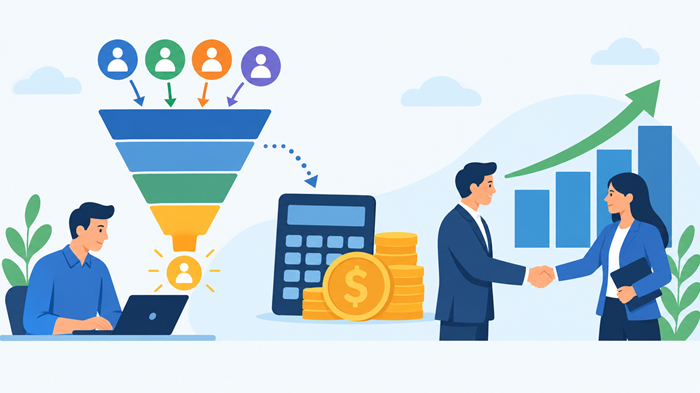
For B2B companies, growth depends on more than generating leads. A business needs to understand how much it spends to turn prospects into paying customers and whether that investment produces enough revenue in return. Customer acquisition cost (CAC) is one of the clearest metrics for measuring the efficiency of a growth strategy. A high CAC can put pressure on margins, while a well-managed CAC can support sustainable growth.
The challenge is that there is no universal CAC number that works for every B2B company. Industry, deal size, sales cycle, target market, pricing model, and marketing channels all influence what a reasonable acquisition cost looks like. Understanding these factors makes it easier to set realistic targets and identify areas where marketing and sales spending can become more efficient.
Key Takeaways
-
A good customer acquisition cost depends on business model, deal value, margins, and sales cycle.
-
CAC should be evaluated alongside customer lifetime value and payback period.
-
B2B companies can lower acquisition costs through better targeting, content, automation, and conversion optimization.
-
Tracking CAC by channel gives businesses a clearer picture of where growth spending is working.
What Is Customer Acquisition Cost?
The customer acquisition cost definition is the total amount a company spends to acquire a new paying customer during a specific period.
This can include marketing expenses, advertising, sales salaries, commissions, software, agency fees, content production, events, and other costs directly associated with acquiring customers.
A simple customer acquisition cost formula is:
CAC = Total Sales and Marketing Costs ÷ Number of New Customers Acquired
For example, a B2B company that spends $30,000 on sales and marketing during a quarter and gains 15 new customers has a CAC of $2,000.
That number alone does not tell the complete story. A $2,000 acquisition cost may be reasonable for a customer generating $20,000 in annual gross profit, but it could be problematic for a customer generating only $3,000.
What Is a Good CAC for B2B Companies?
There is no single figure that can be classified as a good CAC across the entire B2B market.
A SaaS company selling a $500 monthly subscription can tolerate a different acquisition cost from a consulting firm closing $100,000 annual contracts. Similarly, a business serving enterprise clients may spend substantially more to acquire each account because the potential contract value is much larger.
Instead of asking only whether CAC is high or low, B2B companies should examine whether acquisition spending produces sufficient economic value.
Several factors influence an appropriate target:
-
Average contract value
-
Gross profit margin
-
Customer retention
-
Sales cycle length
-
Conversion rates
-
Marketing channel costs
-
Sales team efficiency
-
Customer lifetime value
This approach gives management a more useful benchmark than comparing CAC with an unrelated company.
How to Calculate Customer Acquisition Cost
Calculating customer acquisition cost starts with defining the measurement period and deciding which expenses belong in the calculation.
Suppose a company spends $50,000 on marketing and sales in one quarter and acquires 25 new customers.
$50,000 ÷ 25 = $2,000 CAC
The calculation becomes more meaningful when expenses and customers are measured consistently.
A business may also calculate CAC separately for paid advertising, organic search, referrals, outbound sales, events, and social media. Channel-level reporting can reveal major differences in acquisition efficiency.
For example, paid advertising might generate leads quickly but require significant spending, while organic content may take longer to produce results but generate customers at a lower marginal cost.
Why CAC Matters So Much in B2B Marketing
B2B marketing often involves multiple interactions before a prospect becomes a customer. A buyer may discover a company through search, read several articles, attend a webinar, speak with a salesperson, and request a proposal before making a decision.
That makes acquisition economics particularly important.
A company can generate thousands of leads while still struggling financially when those leads require excessive spending or have poor conversion rates. Monitoring customer acquisition cost helps connect marketing activity with actual business outcomes.
This is also where a structured approach to digital marketing services can help.
Customer Acquisition Cost vs. Customer Value
CAC becomes more useful when compared with the value generated by each customer.
Consider two companies:
Company A
-
CAC: $3,000
-
Annual gross profit per customer: $15,000
Company B
-
CAC: $1,000
-
Annual gross profit per customer: $1,500
At first glance, Company B appears more efficient because it spends less to acquire each customer. However, Company A has considerably more economic value available to recover its acquisition investment.
This illustrates why a low acquisition cost is not automatically better.
B2B organizations should examine CAC alongside retention, margins, recurring revenue, and customer value before making decisions about marketing budgets.
What Factors Increase B2B CAC?
Several challenges can push acquisition costs upward.
Long Sales Cycles
Enterprise and complex B2B purchases may involve multiple decision-makers, technical reviews, demonstrations, negotiations, and procurement stages.
More sales activity generally means greater acquisition expense.
Low Lead-to-Customer Conversion
A company may generate plenty of inquiries but acquire relatively few customers. Poor qualification, weak messaging, unclear offers, or ineffective follow-up can increase acquisition costs.
Broad Targeting
Marketing to an audience that is too broad can waste advertising and sales resources.
Clear ideal-customer profiles help businesses concentrate resources on prospects with a stronger likelihood of becoming customers.
High Competition
Competitive markets can increase advertising costs and make it harder for a company to gain visibility through paid and organic channels.
Strong positioning and differentiated messaging become increasingly important in these situations.
How B2B Companies Can Reduce CAC
Reducing customer acquisition cost does not necessarily mean cutting the marketing budget.
The goal is to improve the amount of revenue and value produced by the existing investment.
Improve Lead Qualification
Sales teams can prioritize prospects based on company size, industry, buying intent, budget, business needs, and fit.
Better qualification reduces the time spent on opportunities that are unlikely to convert.
Strengthen Conversion Paths
Landing pages, forms, calls to action, email sequences, and sales materials should move prospects toward a clear next step.
Small improvements in conversion rates can have a meaningful effect on acquisition economics.
Build Long-Term Organic Traffic
Search-optimized content can attract prospects without requiring a separate advertising payment for every visit.
Educational content also helps B2B buyers research problems before contacting a sales team.
Use Social Media Strategically
Social channels can support awareness, authority, and lead generation when content is designed around the needs of a specific business audience.
For companies developing this channel, the smart guide to b2b leads through social media provides a useful framework for connecting social activity with lead generation.
Automate Repetitive Marketing Tasks
Marketing automation can handle activities such as lead nurturing, segmentation, follow-ups, and reporting.
Automation allows teams to spend more time on strategy and higher-value customer interactions.
How Much Should a B2B Business Spend on Customer Acquisition?
The answer depends heavily on the economics of the business.
A company with high-value contracts and strong margins may justify a larger acquisition investment than a company selling lower-priced services.
Budget planning should consider expected revenue, gross margin, conversion rates, retention, and the amount of capital the business can comfortably invest before customers become profitable.
Businesses evaluating their spending can also review how much should small businesses spend on digital marketing to understand the broader relationship between marketing investment and company size.
Rather than setting an arbitrary CAC ceiling, management can establish a target based on customer economics and then monitor performance against that target over time.
How CAC Differs Across B2B Business Models
Acquisition costs vary significantly between business models.
A professional services firm may depend heavily on referrals, networking, content, and relationship-driven sales. A SaaS company may use paid search, product demonstrations, free trials, email marketing, and outbound campaigns.
An enterprise technology provider can have a lengthy sales process involving several stakeholders. Meanwhile, a smaller B2B service provider may close deals within weeks.
These differences make broad industry averages less useful than company-specific historical data.
Tracking acquisition costs over several quarters gives businesses a stronger internal benchmark. It also makes it easier to identify sudden increases caused by rising advertising costs, lower conversion rates, longer sales cycles, or changes in customer quality.
CAC Payback Period and Business Growth
Another useful metric is the CAC payback period.
This measures how long it takes for the gross profit generated by a new customer to recover the acquisition investment.
For example, a company spending $6,000 to acquire a customer and generating $1,000 in monthly gross profit from that customer has a simple six-month payback period.
A shorter payback period can reduce pressure on cash flow and allow a business to reinvest in growth more quickly.
The metric becomes particularly important for subscription businesses because customers may generate revenue over several months or years.
Average CAC Can Hide Important Problems
An average customer acquisition cost can look healthy while individual channels or customer segments perform poorly.
Suppose a company reports a $2,500 overall CAC. That figure may combine:
-
$1,200 CAC from organic search
-
$2,000 CAC from referrals
-
$4,500 CAC from paid advertising
-
$3,800 CAC from outbound campaigns
Looking only at the overall number hides these differences.
Segmenting acquisition costs by channel, campaign, product, customer size, and geography can provide a much clearer picture.
This information can guide budget allocation without relying on assumptions.
How JNA Can Help Businesses Improve CAC
Improving customer acquisition economics requires more than tracking one number.
JNA has an experienced team that helps businesses evaluate their marketing activities, identify opportunities for improvement, and build strategies around measurable growth. We combines marketing strategy and execution with a focus on helping businesses understand which activities contribute to measurable growth.
The process can involve reviewing acquisition channels, audience targeting, content performance, conversion paths, campaign data, and sales processes.
Businesses can also explore digital marketing consultant near me when looking for professional guidance on developing and improving their marketing strategy.
A practical strategy should connect marketing activity with qualified leads, sales opportunities, and customers rather than treating traffic or impressions as the final goal.
How to Know When CAC Is Too High
A rising customer acquisition cost deserves attention when it begins to reduce profitability, extend payback periods, or make growth financially difficult.
Warning signs can include:
-
Marketing costs increasing faster than revenue
-
Declining conversion rates
-
Longer sales cycles
-
Increasing cost per qualified lead
-
Lower customer retention
-
Reduced margins
-
Heavy dependence on one expensive acquisition channel
The right response depends on the underlying cause.
A sudden increase may come from higher advertising prices, while a gradual increase could indicate market saturation or weakening conversion performance.
Businesses should diagnose the cause before simply reducing spending.
What Happens When Businesses Ignore CAC?
Ignoring customer acquisition cost can make growth appear healthier than it really is.
A company may report increasing leads and sales while spending progressively more to generate each new customer. Over time, this can reduce margins and restrict the money available for product development, hiring, customer service, and expansion.
Understanding acquisition economics creates a clearer connection between marketing activity and financial performance.
Companies exploring the financial impact can also examine how much revenue is your business losing without digital marketing to consider the opportunity cost associated with an underdeveloped digital strategy.
A Practical CAC Measurement Framework
A simple measurement system can make CAC easier to manage.
Start by tracking total sales and marketing costs every month. Record the number of new customers acquired during the same period and calculate the resulting acquisition cost.
Next, segment the data by marketing channel and customer type.
Then compare those figures with customer value, gross margins, retention, and payback periods.
Finally, review the numbers regularly rather than treating CAC as a one-time calculation.
This process helps management identify trends early and make more informed decisions about where to invest.
Final Thoughts on B2B CAC
There is no universal customer acquisition cost that qualifies as good for every B2B company.
The right benchmark depends on the economics of the business, including deal value, margins, retention, sales cycle, and acquisition channels. A higher CAC can make sense when customers generate substantial long-term value, while a lower CAC can still be problematic when customer value is limited.
The most useful approach is to establish a company-specific benchmark, track performance by channel, and continuously improve the path from prospect to customer.
For B2B organizations, customer acquisition cost should not be viewed as just another marketing metric. It is a business-growth metric that helps determine whether the money invested in acquiring customers is producing sustainable results.
FAQs
What is a good CAC for a B2B company?
A good CAC is one that can be recovered profitably based on customer value, margins, retention, and payback period.
How is B2B CAC calculated?
B2B CAC is calculated by dividing total sales and marketing costs by the number of new customers acquired during the same period.
Why does B2B CAC vary by industry?
CAC varies because industries have different contract values, sales cycles, margins, competition levels, and customer acquisition channels.
How can a business lower CAC?
Businesses can reduce CAC through better targeting, stronger conversion rates, organic content, lead qualification, automation, and channel optimization.
Should CAC be measured monthly?
Monthly tracking is useful for identifying trends, while quarterly and annual reviews provide a broader view of acquisition efficiency.