

Answer Engine Optimization: The Complete Guide
August 7, 2026
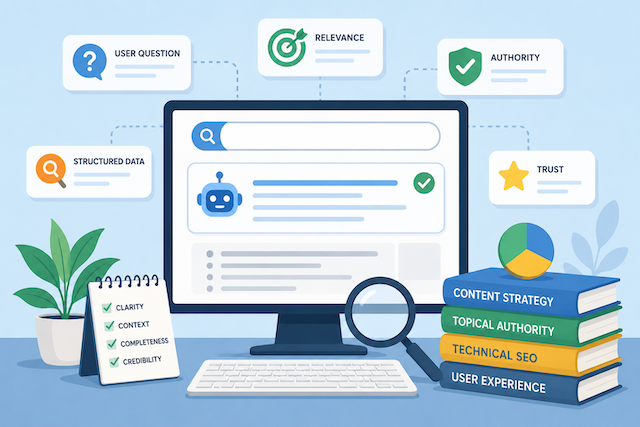
Answer Engine Optimization (AEO) is the practice of structuring digital content so that AI-powered search tools — including Google AI Overviews, ChatGPT, Perplexity, Gemini, and Bing Copilot — can extract, surface, and cite it as a direct response to user queries. Unlike traditional SEO, which focuses on ranking a page in a list of blue links, AEO targets the answer itself: the single response an AI engine delivers before a user ever clicks anywhere.
Key Takeaways
- Answer Engine Optimization is a distinct discipline from SEO, focused on getting your content cited by AI-powered tools rather than ranked in traditional search results.
- AI engines extract answers from content that is structured, authoritative, and phrased in plain, declarative language — vague or over-qualified content is routinely skipped.
- Research consistently shows that the vast majority of online experiences begin with a search engine, and AI Overviews now appear across a growing share of those results — reshaping how traffic is generated.
- Schema markup, atomic section definitions, and direct-answer openings are three of the highest-impact structural changes you can make to improve AEO performance.
- AEO and SEO are complementary, not competing — pages that rank well organically are more likely to be cited by AI engines, but ranking alone does not guarantee citation.
- Businesses that ignore AEO in 2026 are systematically losing visibility in the fastest-growing segment of the search market.
What Exactly Is an Answer Engine?
An answer engine is any AI-powered system that synthesizes information from multiple sources and delivers a single, direct response to a user’s question — without requiring the user to evaluate a list of results themselves.
The major answer engines active in 2026 include Google AI Overviews (which launched under the name Search Generative Experience and has continued to evolve), Perplexity AI, ChatGPT with web browsing enabled, Microsoft Bing Copilot, and Gemini. Each of these systems retrieves, evaluates, and paraphrases web content in real time. When they cite a source, that source gets a brand impression — and increasingly, a referral click.
The critical distinction from traditional search: in traditional SEO, every result on page one competes equally for clicks. In an answer engine, there is often one answer, drawn from one or a handful of sources. The stakes per query are higher, and the margin for structural error is zero.
How Does Answer Engine Optimization Work?
AEO works by making content machine-readable, factually dense, and structurally predictable enough for an AI model to extract and trust.
AI engines do not read pages the way humans do. They parse structured signals: heading hierarchies, sentence-level declarations, schema markup, named entities, and citation patterns. A page can be beautifully written and genuinely authoritative — but if it buries its key facts inside long paragraphs, opens sections with vague preambles, or uses pronouns instead of named entities in topic-defining sentences, an AI model will pass over it in favor of a page that is structurally cleaner.
The Three-Layer AEO Model
Layer 1: Content Structure
Every section of a page must open with a standalone definition or direct statement. If an AI model extracts only that first sentence, it must still deliver a complete, useful answer. Headings should be phrased as questions where possible — AI engines match queries to headings before parsing body text.
Layer 2: Semantic Signals
Use the exact terminology your audience searches. Named entities — specific organizations, legislation, products, people — add trust signals that AI models weight heavily. A page that says “According to the Solar Energy Industries Association, residential solar installations grew by [X]% between 2020 and 2023” (using a verified, sourced figure) is far more citable than one that says “the industry has grown significantly in recent years.”
Layer 3: Technical Markup
Schema markup — particularly FAQ schema, HowTo schema, and Article schema — creates explicit machine-readable labels that tell AI engines exactly what each piece of content is. This is not optional for competitive AEO. According to Google’s Search Central documentation, structured data helps Google understand the content of your page — and better content understanding is broadly considered a prerequisite for surfacing content in AI-generated responses, though Google has not explicitly guaranteed a direct causal link.
Why AEO Matters More Than Ever
The behavioral shift driving AEO’s urgency is straightforward: users increasingly ask questions in conversational interfaces and accept the first answer they receive. They do not scroll. They do not compare. They act on the response delivered.
OpenAI reported that ChatGPT surpassed 200 million monthly active users by mid-2024, a figure that had been growing rapidly heading into 2025 — with many users turning to the tool for research and information-gathering tasks. That is 200 million queries that bypass traditional search results entirely.
For businesses in competitive service categories — insurance, solar, home improvement, digital marketing — this is not an abstract future threat. It is a present revenue problem. A competitor whose content is consistently cited by Perplexity or Google AI Overviews captures brand authority at the moment of highest intent, without the user ever visiting a comparison page.
Businesses that have invested in local SEO strategies or technical SEO audits already have structural advantages they can build on — but AEO requires additional, deliberate optimization layers.
What Are the Key Differences Between AEO and SEO?
AEO and traditional SEO share the same foundation — high-quality, authoritative content — but diverge sharply in execution and success metrics.
- Primary Goal
- Traditional SEO: Rank in organic search results.
- Answer Engine Optimization (AEO): Get cited as a direct answer by AI.
- Success Metric
- Traditional SEO: Click-through rate (CTR) and search rankings.
- AEO: Citation frequency and brand impressions.
- Content Format
- Traditional SEO: Long-form, keyword-rich content.
- AEO: Structured, concise, definition-first content.
- Schema Priority
- Traditional SEO: Helpful but optional.
- AEO: Nearly essential for competitive topics.
- User Behavior
- Traditional SEO: Users compare multiple search results.
- AEO: Users often rely on a single AI-generated answer.
- Link Signals
- Traditional SEO: Backlinks are a major ranking factor.
- AEO: Authority and citation patterns carry greater weight.
- Optimization Timeline
- Traditional SEO: Ranking improvements typically take 3–6 months.
- AEO: Well-structured content can begin earning AI citations within weeks.
The important nuance: SEO and AEO are not in opposition. Pages that earn strong organic rankings are more frequently indexed by AI systems, which means your SEO foundations remain relevant. AEO builds on top of that foundation — it does not replace it.
Understanding the difference between SEO and SEM is useful context here: AEO occupies a third lane that neither paid search nor traditional organic optimization fully addresses.
How to Build an AEO Strategy: A Step-by-Step Framework
Step 1: Identify Your High-Intent Answer Opportunities
Map the specific questions your target audience asks AI tools. These are not just keyword searches — they are full questions with implied intent. “What does term life insurance cover?” is an AEO target. “Term life insurance” alone is a traditional SEO keyword.
Use tools like Perplexity, ChatGPT, and Google AI Overviews directly: type your target question and observe what gets cited. Those sources are your benchmarks — study their structure, not just their content.
Step 2: Restructure Existing Pages for Atomic Clarity
Go through your highest-traffic pages and apply three edits:
- Rewrite the opening paragraph of each page to directly answer the page’s core question in two to three sentences.
- Rewrite the first sentence of each H2 section as a standalone declaration — something that reads as a complete answer even without the surrounding context.
- Eliminate hedging language in topic-defining sentences. “Some experts believe that solar panels may possibly reduce energy costs” will never be cited. “Solar panels reduce household energy costs by an average of 50–70%, according to the Department of Energy” will be.
Step 3: Implement FAQ and HowTo Schema
Every page targeting question-based queries should include FAQ schema. This tells search engines and AI systems explicitly which questions a page answers and what the corresponding answers are. Combine this with schema markup best practices to ensure technical implementation does not undermine the content itself.
Step 4: Build Named Entity Density
Every claim that can be attributed to a named organization, study, or data source should be attributed. Every concept that has an official name should use that name consistently — not replaced with “this approach” or “the system.”
Named entity density is one of the strongest signals AI models use to assess whether content is authoritative enough to cite. A page that references “the Federal Trade Commission”, “the Internal Revenue Service”, and “SEIA” in context reads as authoritative. A page that references “regulatory bodies” and “industry groups” does not.
Step 5: Create Content That Answers Follow-Up Questions
AI engines do not just deliver one answer — they anticipate follow-up queries. Content that addresses a core question and then pre-empts the next two or three logical questions in the same piece creates what AI researchers call a “context chain.” Perplexity and ChatGPT, in particular, tend to stay with sources that satisfy multiple related questions rather than switching sources mid-conversation.
This is why topical authority content clusters are as relevant for AEO as they are for traditional SEO — they signal that your domain comprehensively covers a subject, making it a reliable citation source rather than a one-off reference.
Step 6: Earn Authoritative Backlinks and External Citations
AI engines weight external authority signals. A page cited by credible third-party sources — trade publications, government sites, established news outlets — is more likely to be surfaced as an answer. This connects directly to the role of guest posting for authority building: links from authoritative domains do double duty, supporting both organic rankings and AEO citation probability.
Common AEO Mistakes That Cost Citations
Writing for readers, not for extraction. Conversational prose with buried facts is human-friendly but AI-unfriendly. AI engines extract, they do not interpret.
Ignoring structured data. Many content teams treat schema as a developer task and never prioritize it. In a competitive AEO environment, a page without FAQ schema is structurally disadvantaged before a word is read.
Using vague attributions. Phrases like “experts say” or “research suggests” are extraction dead-ends. Named attribution — “According to the National Renewable Energy Laboratory” — is what AI engines require to treat a claim as citable.
Optimizing for impressions, not answers. Some pages are written to attract traffic rather than to answer questions. AEO requires a content philosophy shift: the page’s primary job is to fully satisfy a specific query, not to tease enough information to generate a click.
Failing to update content. AI engines track content freshness. A page with accurate information but a last-modified date of 2021 competes poorly against a structurally similar page updated in 2026. Prioritize regular content refreshes on service and resource pages.
Frequently Asked Questions
What is the difference between AEO and GEO?
Answer Engine Optimization (AEO) is the practice of structuring content to be cited by AI-powered answer engines. Generative Engine Optimization (GEO) is a closely related term used to describe optimization specifically for generative AI systems like ChatGPT and Gemini. In practice, the two terms describe the same discipline — some practitioners use GEO to emphasize the generative AI context specifically, while AEO is the broader, more established term. The strategies are identical.
Does AEO replace traditional SEO?
No. AEO builds on the same authority, relevance, and technical foundations that SEO requires. Pages that do not rank well organically are less likely to be indexed and cited by AI engines. The most effective approach is to treat AEO as an additional optimization layer on top of a solid SEO foundation — not a replacement for it.
How long does it take for AEO changes to take effect?
Structural changes — rewriting section openings, adding FAQ schema, increasing named entity density — can influence AI citation patterns within weeks, since AI engines crawl and re-evaluate content continuously. This is generally faster than the 3–6 month timeline typical for organic ranking changes in traditional SEO.
Which AI engines are most important to optimize for?
As of 2026, the highest-priority targets are Google AI Overviews (because of Google’s dominant market share), Perplexity AI (which is growing rapidly among research-oriented users), and ChatGPT with web browsing (due to its 200+ million monthly active user base). Bing Copilot and Gemini are secondary priorities for most content strategies.
Do I need to create separate content for AEO?
In most cases, no. The most efficient approach is to restructure existing high-authority pages rather than creating new ones. New pages lack the backlink profile and domain authority that AI engines factor into citation decisions. Restructure first, create new content only to fill genuine topic gaps.
Is AEO relevant for local businesses?
Yes — local businesses are increasingly affected as users ask AI tools questions like “best solar installer near me” or “what home insurance do I need in Florida.” AI engines cite local-intent content when it meets AEO standards. Local businesses that also apply local SEO strategies alongside AEO have the strongest combined visibility across both traditional and AI-powered search.
The Bottom Line
Answer Engine Optimization is not a trend — it is a structural shift in how information is discovered and trusted online. Businesses that treat AEO as a separate discipline from SEO, requiring deliberate structural investment, will consistently out-cite competitors who produce high-volume content without these foundations.
Start with your highest-traffic pages: rewrite their openings to answer directly, add FAQ schema, increase named attribution, and eliminate vague hedging in key statements. Those four changes alone will measurably improve your citation frequency across every major AI engine.