

PPC vs SEO: What’s the Real Difference for Businesses?
September 17, 2026
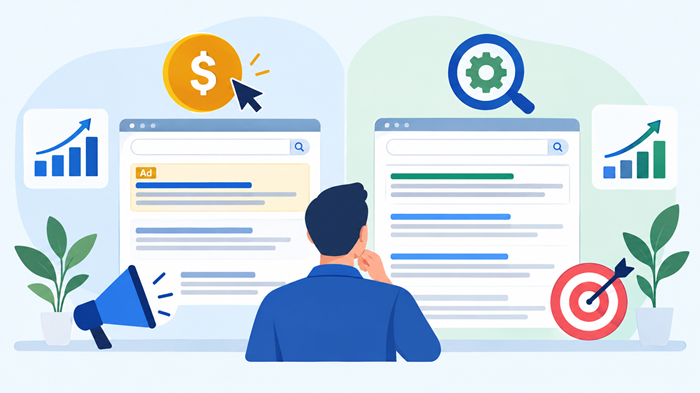
When businesses want more website traffic, leads, and sales, two strategies often come into the conversation: paid search advertising and search engine optimization. Understanding the difference between them makes it easier to decide where marketing resources should go. The ppc vs seo conversation is not simply about paid traffic versus free traffic; it involves differences in cost, speed, visibility, targeting, conversions, and long-term growth.
Key Takeaway
-
PPC can generate targeted website traffic quickly, while SEO generally takes longer to build.
-
SEO can create sustainable organic visibility without paying for every individual click.
-
PPC provides precise control over budgets, audiences, keywords, and campaigns.
-
Combining both strategies can create a more balanced search marketing approach.
What Is PPC?
PPC, or pay-per-click advertising, is a digital advertising model where businesses pay when someone clicks on an advertisement. Search platforms display these ads when users search for keywords relevant to an advertiser’s campaign.
For example, a company selling accounting software may bid on keywords related to accounting solutions. When the campaign is eligible, its advertisement can appear prominently in search results.
One major advantage of PPC is speed. A properly structured campaign can start generating targeted visits shortly after launch. Businesses can also control daily budgets, geographic targeting, ad messaging, landing pages, and audience characteristics.
However, PPC requires ongoing investment. Traffic generally stops when advertising spend is paused, making campaign management, optimization, and budget control important parts of the process.
What Is SEO?
SEO, or search engine optimization, focuses on improving a website’s visibility in organic search results. Instead of paying for each click, businesses optimize their website, content, technical structure, and authority to earn stronger organic rankings.
SEO can involve keyword research, content development, internal linking, technical improvements, page experience, and earning relevant backlinks.
The main distinction in the ppc vs seo discussion is how visibility is acquired. PPC purchases advertising placement, while SEO works toward earning organic search visibility.
SEO usually requires patience because rankings can take time to develop. However, successful optimization can continue attracting relevant visitors without a direct advertising cost attached to every click.
For businesses considering professional support with digital marketing services covering strategies designed to improve online visibility and business performance.
PPC vs SEO: Key Differences
Several factors separate paid search advertising from organic optimization. Looking at these differences side by side provides a clearer understanding of where each approach fits.
Cost Structure
PPC operates around advertising expenditure. Businesses establish campaign budgets and generally pay when users interact with their advertisements.
SEO does not charge a search engine for every organic click. However, it still requires investment in strategy, content, technical work, tools, and professional expertise.
Budget planning is therefore important for both approaches. Businesses exploring costs can review how much should small businesses spend on digital marketing to understand how marketing budgets can be structured.
Speed of Results
PPC can deliver visibility much faster than organic optimization. Once campaigns are approved and properly configured, advertisements can begin appearing for relevant searches.
SEO tends to work differently. Improvements may take weeks or months to produce meaningful ranking changes, particularly for competitive search terms.
This makes PPC useful when immediate traffic matters, while SEO can support a longer-term acquisition strategy.
Traffic Duration
The duration of traffic is another important distinction.
PPC traffic depends on an active advertising campaign and available budget. Stopping the campaign generally means stopping the associated paid traffic.
SEO traffic can continue after individual optimization projects are completed, although rankings require ongoing maintenance because competitors, search algorithms, and user behavior change.
This difference is one reason businesses often consider the ppc vs seo digital marketing differences when developing annual marketing plans.
Targeting and Control
PPC offers extensive campaign-level control. Advertisers can select keywords, locations, audiences, schedules, devices, bids, advertisements, and landing pages.
SEO offers less direct control over exactly when and where a page appears. Search engines determine organic rankings based on numerous signals and continuously evolving systems.
The trade-off is straightforward: paid campaigns offer more immediate control, while organic search depends more heavily on relevance, quality, authority, and technical performance.
PPC vs SEO Conversion Rates
Conversion performance depends on far more than the traffic source. Landing-page quality, search intent, pricing, brand reputation, offer strength, website usability, and industry all influence whether visitors become leads or customers.
That is why ppc vs seo conversion rates cannot be reduced to one universal percentage.
A highly targeted paid advertisement may attract visitors with strong commercial intent. Meanwhile, a well-ranked organic page can capture users researching a problem, comparing options, or looking for a solution.
The right measurement approach is to track qualified leads, sales, revenue, cost per acquisition, and conversion rates by channel rather than focusing only on visitor volume.
PPC vs SEO Difference in Digital Marketing
The ppc vs seo difference digital marketing teams consider often comes down to acquisition mechanics.
PPC is an advertising channel that can provide immediate exposure and measurable campaign-level control. SEO is an organic acquisition strategy that focuses on building search visibility over time.
Neither approach exists in isolation. Search behavior often moves across multiple stages. Someone may first discover a company through an advertisement, later return through an organic result, and eventually convert after visiting the website several times.
Businesses should therefore evaluate both channels based on their objectives, customer journey, resources, and timeframe.
For a broader explanation of channel roles, digital marketing vs social media can also help clarify how search fits into a wider online marketing strategy.
When PPC Makes Sense
PPC can be particularly useful when a business needs immediate visibility, wants to promote a time-sensitive offer, or is entering a competitive market where organic rankings have not yet developed.
Paid campaigns can also provide valuable keyword and audience data. Marketers can observe which search terms attract clicks, leads, and sales, then use those insights to improve broader marketing efforts.
Campaign performance should be reviewed regularly. Poorly matched keywords, weak advertisements, irrelevant landing pages, and inefficient bidding can consume budget without producing meaningful business outcomes.
Understanding how to choose the right ppc agency can be useful when external expertise is needed for campaign planning and management.
When SEO Makes Sense
SEO is particularly valuable for businesses seeking sustainable organic visibility and a steady flow of relevant search traffic.
A strong SEO strategy can target informational searches, commercial keywords, local queries, product searches, and other stages of the customer journey.
SEO can also strengthen a company’s digital presence beyond individual rankings. Useful content can answer customer questions, establish topical authority, support internal navigation, and create additional opportunities to attract qualified visitors.
Businesses should approach SEO as an ongoing marketing investment rather than a one-time task. Search competitors continue publishing content and improving their websites, so maintaining visibility requires consistent attention.
Companies evaluating professional optimization can learn more about when to hire SEO agency support and what that process can involve.
PPC vs SEO for Business Growth
The question of ppc vs seo for business growth is best approached according to business goals rather than treating one channel as universally suitable.
A new business may use PPC to generate initial visibility while building its organic presence. An established company may use SEO to capture consistent search demand while running paid campaigns around high-value commercial terms.
The two channels can also reinforce each other. PPC data may reveal valuable keywords for SEO content, while strong organic pages can provide useful destinations for paid campaigns.
Looking beyond traffic is essential. Businesses should connect marketing activity to measurable outcomes such as qualified inquiries, purchases, customer acquisition costs, and revenue.
For additional perspective on performance expectations, businesses can explore what you can expect from digital marketing.
Should Businesses Use PPC or SEO?
Choosing between PPC and SEO depends on the situation.
Businesses that need immediate exposure may place greater emphasis on paid campaigns. Companies focused on long-term organic visibility may invest more heavily in SEO. Many organizations use both to diversify their search acquisition strategy.
The practical approach is to consider budget, competition, sales cycle, customer intent, existing website authority, and expected timeframe.
JNA is positioned as an agency supporting businesses across both paid and organic digital marketing, allowing companies to consider PPC and SEO as connected parts of a broader acquisition strategy rather than completely separate activities.
How PPC and SEO Can Work Together
Using both channels can create useful opportunities across the customer journey.
PPC can capture immediate demand for competitive commercial searches. SEO can build visibility for valuable topics and queries that continue generating interest over time.
Paid search can also help identify high-performing keywords before a company invests heavily in long-term organic content. Similarly, SEO research can reveal search themes that may be suitable for paid campaigns.
This integrated approach can make the ppc vs seo discussion less about choosing one channel and more about determining how both can contribute to a measurable marketing system.
Measuring the Right Results
Traffic alone is not enough to determine marketing performance.
Businesses should monitor metrics such as:
-
Qualified leads
-
Sales and revenue
-
Conversion rate
-
Cost per acquisition
-
Return on advertising spend
-
Organic search traffic
-
Keyword visibility
-
Landing-page performance
The appropriate metrics depend on the business model. An e-commerce company may prioritize revenue and transaction value, while a B2B company may focus more heavily on qualified leads and sales opportunities.
A channel that produces large traffic numbers may not necessarily generate the strongest commercial results. Measurement should connect marketing activity to actual business objectives.
Final Thoughts
Understanding the ppc vs seo distinction helps businesses make more informed digital marketing decisions. PPC offers speed, control, and immediate paid visibility, while SEO focuses on building organic search presence that can deliver value over the longer term.
The strongest strategy depends on the company’s objectives, resources, competitive environment, and customer journey. Rather than treating paid and organic search as competing ideas, businesses can use the strengths of each channel to create a more complete acquisition strategy.
JNA can support businesses across both PPC and SEO, helping connect search marketing activity with measurable business goals.
Frequently Asked Questions
Is PPC better than SEO?
PPC and SEO serve different purposes, so the appropriate choice depends on goals, budget, competition, and desired timeframe.
How long does SEO take to work?
SEO timelines vary, but meaningful organic improvements often require consistent optimization and content work over an extended period.
Can PPC and SEO be used together?
Yes, businesses can use PPC for immediate paid visibility while developing SEO for longer-term organic search growth.
Is SEO free?
Organic clicks do not require a per-click advertising payment, but effective SEO requires investment in strategy, content, technical work, and expertise.
Which keywords should businesses target?
Keyword selection should reflect search intent, business relevance, competition, customer needs, and potential commercial value.