

How Local SEO Helps Multi-Location Businesses Grow
August 13, 2026
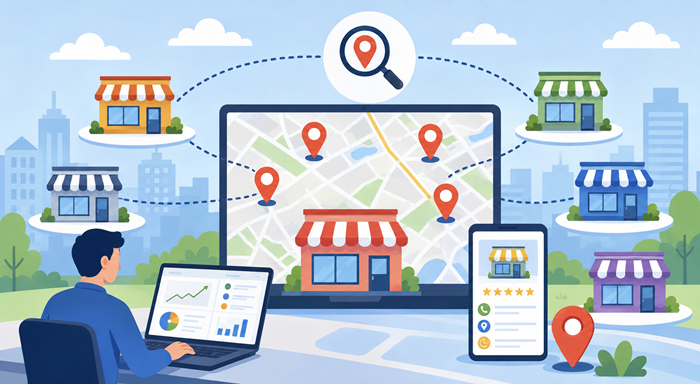
Managing a business with multiple locations comes with a unique marketing challenge: every branch needs to be visible to nearby customers while still feeling like part of the same brand. That is where local SEO becomes especially valuable. Instead of sending every customer to one generic website page, businesses can build visibility around individual locations, neighborhoods, services, and search intent.
For multi-location companies, the goal is not simply to rank higher. It is to make the right location appear when someone nearby searches for a product or service, then give that customer enough relevant information to take action.
Key Takeaways
- Local SEO helps individual business locations appear in relevant nearby searches.
- Consistent location information improves trust and search visibility across branches.
- Strong Google Business Profiles, reviews, location pages, and local content support better performance.
- A centralized strategy makes it easier to scale search marketing as new locations are added.
Why Multi-Location Businesses Need a Different SEO Strategy
A business with one location can often focus its optimization around a single city or service area. Multi-location businesses have a much more complicated search landscape.
Imagine a company operating in 20 cities. A customer searching for a service in one city should ideally see the nearest branch, its opening hours, phone number, reviews, directions, and relevant services—not information about a location hundreds of miles away.
This is one of the biggest reasons local SEO matters for growing brands. Each location has its own customers, competitors, search patterns, and geographic relevance.
A national website can establish brand authority, but individual location signals help search engines understand where each branch serves customers.
How Local SEO Connects Customers With the Right Location
Search engines increasingly try to provide results that match both the user’s intent and location. Someone searching for “roof repair near me” has a different need from someone researching roofing companies nationally.
For multi-location businesses, local SEO creates opportunities to connect these location-specific searches with the most relevant branch.
Location-Based Visibility
Each branch can be optimized around its actual service area rather than relying on one generic location page.
Useful location signals can include:
- City and neighborhood references
- Accurate business information
- Local service pages
- Location-specific customer reviews
- Google Business Profile information
- Local images and business details
- Relevant local backlinks and mentions
These signals help search engines understand the relationship between a business, its physical locations, and nearby customers.
Build Dedicated Pages for Every Business Location
One of the most important parts of a scalable strategy is creating useful location pages.
A location page should provide genuine information about that specific branch. Simply copying the same content and replacing the city name is unlikely to provide much value to users.
A strong page can include:
- Branch address and contact details
- Opening hours
- Services available at that location
- Nearby neighborhoods or service areas
- Directions and parking information
- Local staff or team details where appropriate
- Location-specific testimonials
- Frequently asked questions
- Unique photos
The purpose is simple: when someone lands on the page, they should immediately understand whether that location can help them.
Businesses looking to optimize your business website for local search after google updates can also use these principles to strengthen location-focused pages.
Optimize Google Business Profiles at Scale
Every eligible physical location should have an accurate and properly managed Google Business Profile.
For a multi-location brand, this means keeping information consistent while making each listing genuinely specific to its branch.
Important details include:
- Correct business name
- Accurate address
- Local phone number where appropriate
- Current business hours
- Correct primary and secondary categories
- Relevant services
- Updated photos
- Website URL
- Accurate holiday hours
A well-maintained profile can make the customer journey much easier because searchers can quickly find the information they need.
Businesses can also review how to optimize google business profile for business growth to better understand how profile optimization fits into a broader search strategy.
Reviews Can Strengthen Local Visibility and Trust
Reviews influence more than customer perception. They can also provide valuable signals around a business’s reputation and relevance.
For multi-location companies, it is important to manage reviews at the branch level rather than treating all feedback as one large pool.
Each location should have its own review presence where applicable. Customers can then see feedback from people who actually interacted with that branch.
The power of google reviews becomes especially clear when comparing two nearby businesses offering similar services. A strong review profile can help one location stand out while giving potential customers greater confidence.
The key is to earn genuine reviews through good customer experiences rather than relying on artificial or repetitive review-generation tactics.
Create Content Around Local Search Intent
Publishing content for the sake of adding pages is not enough. Multi-location businesses need content that answers questions customers actually ask.
For example, a home services company might create useful content around common problems in different service areas. A healthcare provider could explain services available at specific clinics. A retail business might create guides connected to local shopping needs.
This is where local SEO can move beyond basic business listings and become a useful content strategy.
Instead of repeatedly inserting city names into generic articles, create information that genuinely reflects the needs of customers in those areas.
Maintain Consistent Business Information
Consistency is critical when a company has dozens or hundreds of locations.
If one directory shows an outdated phone number while another lists an old address, customers can become confused. Inconsistent information can also make it harder for search engines to confidently connect different listings to the same business.
Create a centralized system for managing:
- Business names
- Addresses
- Phone numbers
- Hours
- Website URLs
- Categories
- Location status
- Service availability
This becomes even more important when locations open, close, relocate, or change operating hours.
Use a Scalable Multi-Location SEO Framework
The biggest challenge is often not optimizing one location. It is maintaining quality across many locations.
A scalable framework can establish consistent standards for page structure, metadata, internal linking, business information, review management, and content creation.
At the same time, every location should retain enough unique information to be genuinely useful.
This balance is the foundation of multi location local seo solutions for growing organizations.
A centralized team can create the strategy and standards, while local teams can provide branch-specific information and customer insights.
Local PPC and SEO Can Work Together
Organic search and paid search do not have to operate independently.
Paid campaigns can help businesses gain immediate visibility for important locations, while organic optimization works toward sustainable visibility over time.
Businesses evaluating a local seo service package can consider how paid and organic campaigns can complement each other rather than treating them as completely separate marketing channels.
For example, paid campaigns may help test which services or geographic areas generate strong demand. Those insights can then inform content and organic optimization priorities.
Track Performance by Location
A multi-location strategy should never rely only on overall website traffic.
A business may see strong national traffic while several branches receive very little local visibility.
Track performance at the individual-location level whenever possible.
Useful metrics include:
- Local search visibility
- Google Business Profile interactions
- Direction requests
- Phone calls
- Website clicks
- Local organic traffic
- Location-page engagement
- Review volume and sentiment
- Leads generated by location
This makes it easier to identify branches that are performing well and those that need additional attention.
What Makes the Best Local SEO Strategy Scalable?
The best local seo service approach is not necessarily the one that creates the most pages. It is the one that can maintain quality as the business grows.
A scalable strategy should combine technical SEO, location-specific content, profile management, reputation building, analytics, and ongoing optimization.
It should also have clear processes for adding new branches.
When a new location opens, the marketing team should already know how to create its page, establish its business profile, verify information, collect legitimate reviews, and connect the location to the wider website structure.
Common Mistakes Multi-Location Businesses Should Avoid
Even established companies can make mistakes when expanding their search strategy.
Using Duplicate Location Pages
Copying one location page and changing only the city name creates little value for customers.
Mixing Location Information
Using one branch’s phone number or hours on another branch’s page can create confusion and reduce trust.
Ignoring Individual Reviews
Customers interact with local branches, so reputation management should happen at the location level.
Creating Too Many Thin Pages
Every page should have a clear purpose and provide useful information. More URLs do not automatically mean more visibility.
Forgetting Mobile Users
Many location searches happen when people are ready to call, visit, or request directions. Pages need to be easy to navigate on mobile devices.
When Should You Hire a Local SEO Provider?
Managing a handful of locations may be possible internally, but the workload grows quickly as a company expands.
A dedicated local seo service provider can help establish processes for location pages, business listings, technical optimization, content, reviews, reporting, and ongoing improvements.
This can be particularly useful for franchises, healthcare networks, home service companies, retail chains, restaurants, and professional service businesses with multiple branches.
The right partner should understand the difference between optimizing one location and managing search visibility across an entire network.
Can Affordable Local SEO Work for Multi-Location Businesses?
Yes, but affordability should be measured against scalability and business outcomes rather than simply the lowest monthly price.
An affordable local seo service should still provide a clear strategy, accurate location information, useful content, reporting, and ongoing optimization.
Businesses should also consider prioritizing locations based on opportunity. A new branch in a competitive market may need more attention than an established location already generating strong organic visibility.
The Long-Term Value of Multi-Location Local SEO
As businesses expand, search visibility can become increasingly fragmented without a structured strategy.
Multi location local seo helps create a framework where each branch can compete for relevant searches while remaining connected to the broader brand.
The goal is not to make every location look identical. The goal is to create a consistent customer experience while giving each branch enough local relevance to stand on its own.
When handled properly, local SEO can support visibility throughout the customer journey—from discovery to website visits, calls, directions, reviews, and eventually conversions.
How to Choose the Right Strategy for Your Business
Start by auditing every location.
Check whether each branch has accurate business information, a useful location page, a properly managed Google Business Profile, consistent directory information, and a healthy review presence.
Next, compare performance across locations. Look for branches with strong demand but weak visibility, as these can represent immediate opportunities.
Finally, create a repeatable process for optimization. Local SEO works best as an ongoing marketing discipline rather than a one-time setup.
For companies that need help managing broader digital campaigns, exploring digital marketing services near me can be a useful next step when building a coordinated marketing strategy.
Final Thoughts
Multi-location businesses have a major opportunity to reach customers at the exact moment they are searching for nearby products and services. But achieving that visibility requires more than adding city names to a website.
A strong local SEO strategy combines accurate business information, location-specific pages, Google Business Profiles, genuine reviews, useful content, technical optimization, and location-level performance tracking.
When these elements work together, each branch has a better opportunity to attract relevant customers while the overall brand continues to grow.
FAQs
1. What is local SEO for a multi-location business?
It is the process of improving each business location’s visibility in relevant local search results.
2. Should every business location have its own page?
Yes, each location should have a useful, unique page containing accurate branch-specific information.
3. Do Google reviews matter for multiple locations?
Yes, location-specific reviews can strengthen customer trust and support a branch’s local search presence.
4. How often should multi-location SEO be updated?
Businesses should monitor and update location information, profiles, content, and performance continuously.
5. Can local SEO help new business locations?
Yes, establishing accurate listings and useful location content early can help new branches build search visibility.