

5 Steps of Email Marketing: A Simple Guide for Beginners
October 7, 2026
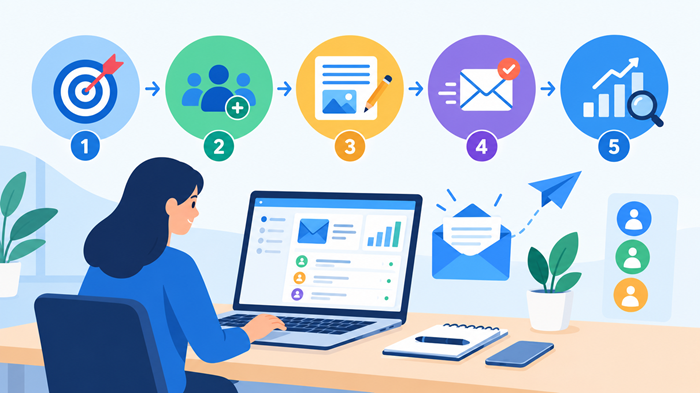
Understanding the 5 steps of email marketing makes it easier for businesses to turn email communication into a consistent source of engagement, leads, and sales. Rather than sending random promotional messages, a structured approach helps you attract the right subscribers, deliver useful content, encourage action, and measure what works.
The process is especially valuable for small businesses because a well-planned email strategy can build relationships without requiring the same resources as many other marketing channels.
Key Takeaways
-
The 5 steps of email marketing are planning, list building, content creation, sending, and measurement.
-
Strong campaigns begin with a clearly defined audience and a permission-based subscriber list.
-
Relevant content, compelling calls to action, and consistent testing improve campaign performance.
-
Tracking results helps businesses refine future messages and make better marketing decisions.
What Are the 5 Steps of Email Marketing?
The 5 steps of email marketing provide a practical framework for moving from strategy to measurable results. They can be summarized as:
-
Define your goals and audience.
-
Build and segment a quality subscriber list.
-
Create valuable and relevant content.
-
Send, test, and optimize your messages.
-
Measure performance and improve future campaigns.
Each stage supports the next. A strong strategy cannot compensate for a poor subscriber list, and an excellent message has limited value when nobody opens or acts on it.
The 5 steps of email marketing also help businesses avoid a common mistake: treating every subscriber as though they have the same needs, interests, and buying intent.
Step 1: Define Your Goals and Audience
The first of the 5 steps of email marketing is deciding what the campaign needs to accomplish. A vague goal such as “get more customers” is difficult to measure, while a specific objective gives the campaign direction.
A business might want to generate more product sales, increase appointment bookings, nurture leads, promote an upcoming event, encourage repeat purchases, or bring inactive customers back.
Identify Your Ideal Subscriber
Once the goal is clear, define the people most likely to benefit from the message. Consider their needs, common problems, buying stage, location, previous interactions, and interests.
For example, a software company may communicate differently with a person who has downloaded a free guide and someone who has already requested a product demonstration.
This audience-first approach is one reason businesses invest in professional email marketing services. A structured strategy makes messaging more relevant instead of relying on one generic message for everyone.
JNA also provides affordable digital marketing services for businesses looking to build a broader online growth strategy alongside their email efforts.
Set a Measurable Objective
Choose a metric that directly connects to the goal. A lead-generation campaign may focus on form submissions, while a sales campaign may prioritize purchases or revenue.
The objective should also have a reasonable timeframe. This makes it easier to determine whether the campaign produced the intended result and where adjustments are needed.
Step 2: Build and Segment a Quality Email List
The second of the 5 steps of email marketing is building a permission-based subscriber list. A large database is not automatically a valuable one.
Quality matters more than quantity because engaged subscribers are more likely to open messages, click links, respond to offers, and become customers.
Use Clear Signup Opportunities
Businesses can collect subscribers through website forms, content downloads, event registrations, checkout processes, consultations, and other relevant customer touchpoints.
The signup process should clearly explain what subscribers can expect. Avoid vague consent language that leaves people unsure about the type of communication they are agreeing to receive.
For organizations marketing to audiences covered by specific privacy and electronic communications rules, consent requirements can vary by jurisdiction. For example, UK ICO guidance states that valid consent for electronic marketing should be freely given, specific, informed, and unambiguous.
Segment Subscribers by Relevance
Segmentation means dividing subscribers into meaningful groups. Useful categories can include:
-
New subscribers
-
Existing customers
-
Prospects
-
High-value customers
-
Location or region
-
Product interest
-
Previous purchase
-
Engagement level
Segmentation allows businesses to make messages more useful without creating completely different strategies for every individual.
For smaller companies, learning more about email marketing for small businesses can also help turn a basic subscriber database into a more organized marketing asset.
Step 3: Create Valuable and Relevant Content
The third of the 5 steps of email marketing focuses on the message itself. Once the audience and objective are defined, the content should give subscribers a clear reason to pay attention.
Strong content does not always need to make a direct sales pitch. Educational information, useful tips, product updates, case studies, answers to common questions, special offers, and helpful resources can all provide value.
Write a Strong Subject Line
The subject line is often the first thing a subscriber sees, so clarity matters. A useful subject line should set an accurate expectation about the message without relying on misleading claims.
Examples include:
-
A practical guide to reducing monthly costs
-
Three ways to improve your website this week
-
Your new customer offer is ready
-
What changed in our latest update?
The best approach depends on the audience and the purpose of the message. Testing different subject-line styles can reveal what resonates with subscribers.
Keep the Message Focused
A good email usually has one primary purpose. Too many competing offers, links, or calls to action can make the message harder to understand.
Start with the most important information, explain the benefit, and finish with a clear action. The call to action might encourage readers to book a consultation, read an article, download a resource, request a quote, or make a purchase.
Businesses exploring whether is email marketing still effective for businesses can use this principle as a useful starting point: effectiveness depends heavily on relevance, audience quality, consistency, and execution rather than simply sending more messages.
Step 4: Send, Test, and Optimize
The fourth of the 5 steps of email marketing is turning prepared content into a well-executed send. Timing, formatting, subject lines, calls to action, and technical details can all influence results.
Choose a Practical Sending Schedule
There is no universal day or time that guarantees success. The best schedule depends on the audience, industry, location, and type of message.
A professional audience may respond during working hours, while a consumer audience could engage at another time. Start with a reasonable schedule, monitor results, and adjust based on actual subscriber behavior.
Consistency is also important. Sending messages only when there is a last-minute promotion can make communication feel unpredictable.
Test Before Sending
A simple quality-control process can prevent avoidable mistakes. Check:
-
Subject line
-
Sender name
-
Links
-
Images
-
Spelling and grammar
-
Mobile formatting
-
Call-to-action button
-
Personalization
-
Unsubscribe option
Testing different versions can also provide useful performance insights. One audience may respond better to a shorter subject line, while another may prefer a more specific benefit.
An appropriate email marketing tool can help businesses manage lists, automate messages, test content, and monitor campaign results from one platform.
Respect Subscriber Preferences
An effective strategy should make it easy for people to unsubscribe or change their preferences. The ICO advises organizations to respect objections and withdrawals of consent and to make opting out straightforward.
This is more than a compliance consideration. Respecting subscriber preferences also protects brand trust and helps maintain a healthier database.
Step 5: Measure Results and Improve
The fifth of the 5 steps of email marketing is measurement. Without reviewing performance, businesses cannot reliably determine which messages are producing useful outcomes.
Common metrics include:
-
Open rate
-
Click-through rate
-
Conversion rate
-
Unsubscribe rate
-
Bounce rate
-
Revenue generated
-
Leads generated
The most important metric depends on the original campaign objective.
For example, a newsletter designed to educate subscribers may prioritize engagement, while a product promotion should place greater emphasis on conversions and revenue.
Look Beyond Open Rates
Open rates can provide useful directional information, but they should not be treated as the only measure of success. A message with strong opens but few clicks may have an interesting subject line but weak content or an unclear offer.
Similarly, a lower open rate does not automatically mean a campaign failed. A smaller audience that produces qualified leads can be more valuable than a larger audience that generates little business.
Use Results to Improve the Next Campaign
Measurement becomes useful when it changes future decisions. Compare campaigns over time and look for patterns in subject lines, topics, offers, audience segments, sending schedules, and calls to action.
Businesses working with limited resources can also review their small business budget on digital marketing to determine how email fits alongside search, social media, content, and other marketing activities.
How an Email Marketing Agency Can Help
The 5 steps of email marketing can be managed internally, but businesses sometimes need additional expertise when their campaigns become more complex.
An email marketing agency can help with strategy, list segmentation, automation, copywriting, campaign planning, testing, reporting, and optimization.
This can be especially useful for companies that have a growing subscriber base but limited internal marketing capacity.
The goal should not simply be to send more emails. Professional support should make the process more strategic, consistent, measurable, and aligned with business objectives.
Choosing the Right Tools for Your Strategy
The right technology can simplify list management, automation, analytics, personalization, and campaign scheduling. However, selecting software based solely on the number of features can lead to unnecessary complexity.
Consider factors such as:
-
Subscriber capacity
-
Automation features
-
Reporting
-
Integration options
-
Ease of use
-
Template flexibility
-
Deliverability support
-
Pricing
-
Customer support
Businesses researching the best digital marketing tools for startups can use similar criteria when comparing platforms for broader marketing operations.
The most suitable platform is one that supports the actual workflow without creating unnecessary administrative work.
Why These Five Steps Work Together
The 5 steps of email marketing are most effective when treated as one connected process rather than five isolated tasks.
Planning determines who should receive the message and why. List building creates the audience. Content gives subscribers something useful to engage with. Sending and testing improve execution, while measurement provides the information needed for the next cycle.
This creates a continuous improvement loop.
For example, performance data may show that one subscriber segment responds strongly to educational content while another responds better to product-focused messages. That information can improve future segmentation and content decisions.
In this way, the 5 steps of email marketing become a repeatable system rather than a one-time promotional activity.
Common Mistakes to Avoid
The 5 steps of email marketing are straightforward, but several mistakes can reduce their effectiveness.
Sending to an Unqualified List
Purchased or poorly sourced lists can contain people who never asked to hear from the business. Permission and relevance are more valuable than simply increasing subscriber numbers.
Making Every Email a Sales Pitch
Constant promotion can reduce engagement. A healthier approach balances commercial messages with useful information that supports the subscriber.
Ignoring Mobile Readers
Many subscribers read messages on mobile devices. Content should therefore be easy to scan, buttons should be accessible, and important information should not depend on a large desktop screen.
Failing to Review Results
A campaign should not end when the message is sent. Performance data should inform the next decision.
Making Unsubscribing Difficult
A clear unsubscribe process protects subscriber choice and supports responsible direct marketing practices.
What Makes a Successful Email Marketing Campaign?
A successful email marketing campaign combines a defined objective, relevant audience, useful content, clear action, appropriate timing, and measurable results.
The strongest campaigns are rarely built around one clever subject line or one promotional offer. They succeed because the entire customer journey is considered.
For example, a new subscriber might first receive a welcome message, followed by educational content, a relevant offer, and later a request for feedback. Each message has a role rather than competing for attention.
This approach also makes automation more useful because messages can be triggered by meaningful subscriber actions instead of being sent randomly.
Final Thoughts
The 5 steps of email marketing offer a simple framework for building a more disciplined and effective communication strategy. Start with a clear goal, build a permission-based audience, create useful content, send thoughtfully, and use performance data to improve.
The process does not need to be complicated. What matters most is consistency, relevance, respect for subscriber preferences, and a willingness to learn from real results.
For businesses ready to develop a repeatable system, the 5 steps of email marketing provide a practical foundation that can grow alongside the organization.
FAQs
1. What are the 5 steps of email marketing?
The five steps are defining goals, building a subscriber list, creating content, sending and testing messages, and measuring results.
2. Why is segmentation important in email marketing?
Segmentation helps businesses send more relevant messages to subscribers based on their interests, behavior, or customer stage.
3. How often should a business send marketing emails?
A business should choose a consistent frequency that provides value without overwhelming subscribers.
4. What should an email marketing campaign include?
A strong campaign should include a clear objective, relevant content, a compelling call to action, and a measurable outcome.
5. How can businesses improve email campaign performance?
Businesses can improve results by testing content, segmenting audiences, reviewing metrics, and applying insights to future campaigns.